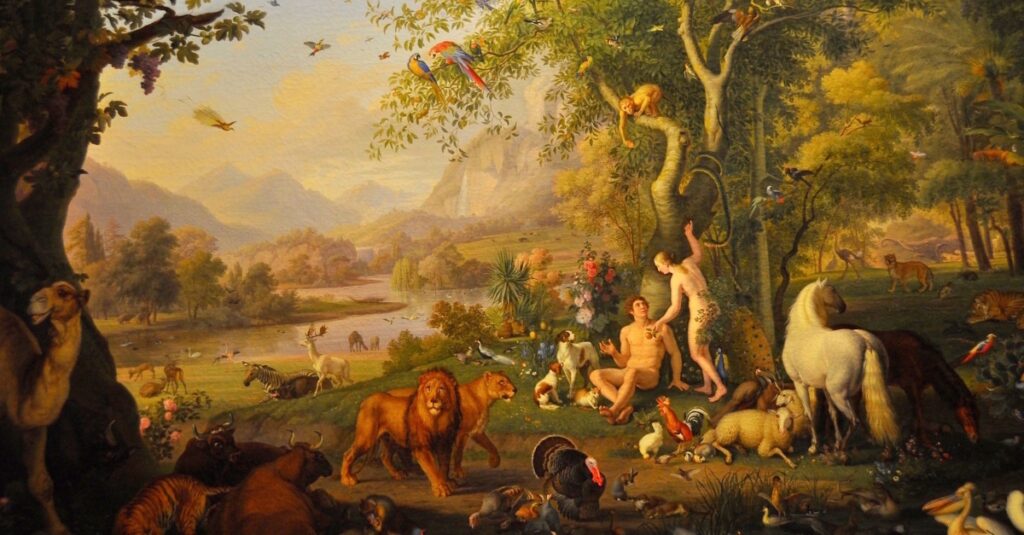
What creates human connection? I like to look at backyards. They reveal what people love to surround themselves with. Whether we realize it or not, most of us unconsciously — and sometimes consciously — try to re-create the Garden of Eden behind our homes.
We intentionally gather things that make us feel safe, calm, and at home. When we see those trees, bushes, flowerbeds, firepits, patios, swings, zip-lines, saints, and everything else we’ve placed there, we feel as if we’re standing inside our own Garden of Eden. Having such a space gives us a sense of safety.
The enclosure of the backyard becomes a protective wall, symbolically shielding us from the chaos of the outside world. And every “thing” within that enclosure speaks to us.
The word “Paradise” itself comes from the Old Persian “pairidaeza,” which means “enclosed garden” or “walled enclosure.” In the Bible, it first appears in the Septuagint. The word consists of two parts: “pairi-” (around) and “-daeza” (wall or enclosure).
Paradise is an enclosure — a place surrounded by a wall. It’s an enclosed circle. Within this circle, everything is secure. Outside of it, danger lurks. Little children understand the meaning of Paradise when they cling to their mother’s knees. They instinctively remain within their safe zone — an invisible enclosure — until they feel secure enough to venture out.
On this side of the Garden of Eden, we must have some form of enclosure — a place full of mighty Guardians that keep watch day and night at the borders of our realm. We must feel protected from the outside world — to build immunity within.
Without Paradise, no one feels safe enough to venture into the big, wide world. Without the experience of being surrounded by Guardians — our own symbolic gargoyles — the world will swallow us. Paradise is necessary for building immunity. And, paradoxically, immunity is what makes community possible.
True community is impossible without immunity. Unless I feel safe — unless I catch a glimpse of my own protective gargoyles out of the corner of my eye — I cannot truly connect with anyone. My ability to dwell in community is directly related to my experience of immunity within my Paradise.
If I lack the experience of Paradise, I will lack the immunity needed to commune. And without immunity, all connection is fragile or distorted. Only those who feel safe enough — loved, enclosed, embraced — can form true community. Those who do not feel safe, loved, enclosed, and embraced cannot connect in a healthy way.
Communism, incidentally, is the crisis of distorted community — precisely because communism arises from a crisis of immunity. It is the opposite of true community because it emphasizes the communal at the expense of the individual.
When individual boundaries are erased — when there is no sufficient enclosure around us — we lose the ability to connect in a healthy way. Communism emerges from a distorted vision of community.
When the individual is swallowed by the collective, neither individuality nor community survives. To have true community, there must first be immunity. Each of us must have the experience of dwelling in a “walled enclosure” where we feel totally safe, loved, and embraced — only then can we truly connect.
God planted the Garden in the East for this very purpose: to surround Adam and Eve with enough love for true community to emerge. Without Paradise, true community becomes impossible — and Communism becomes inevitable.