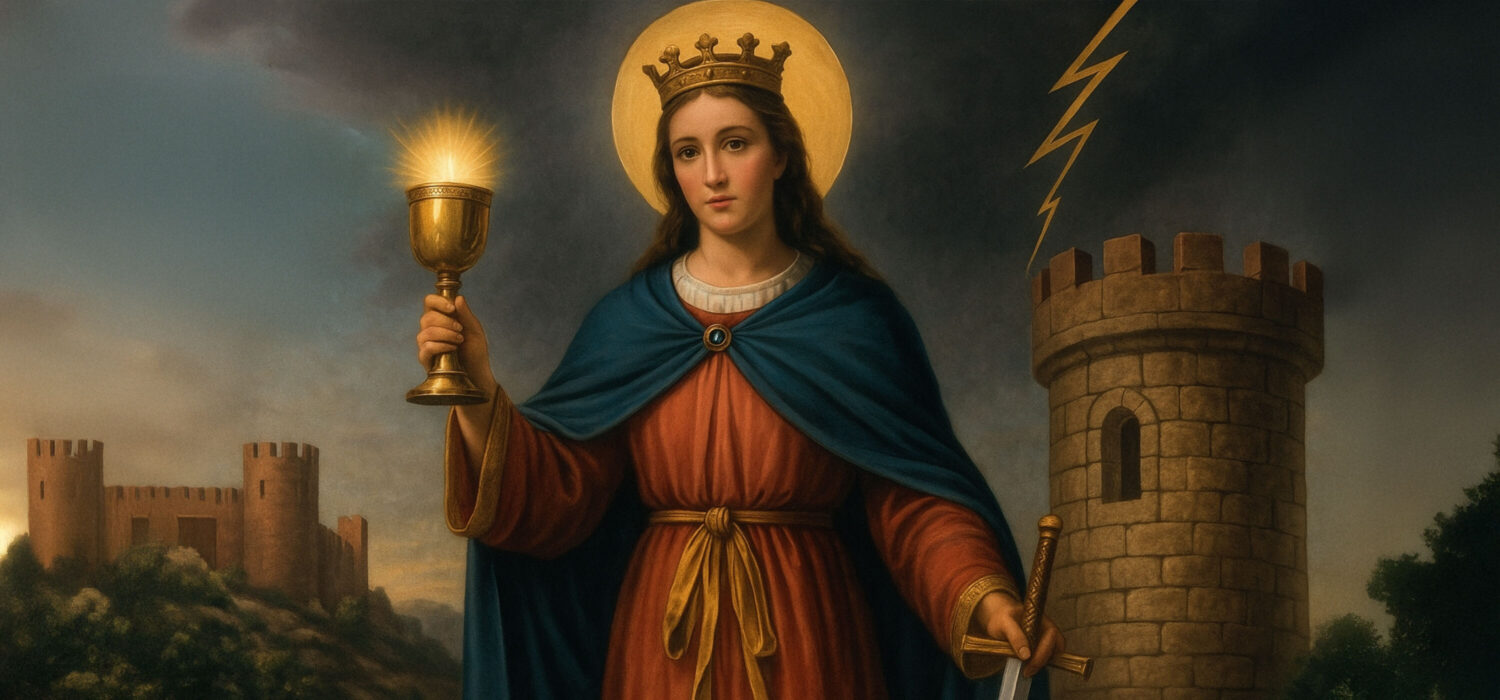
What was Saint Barbara’s miracle? According to the legend, Saint Barbara was a beautiful young woman who lived in the 3rd century AD. Her father, Dioscorus, was a pagan and kept her locked in a tall tower to protect her from the world. Barbara didn’t mind — until one day, she made a strange request.
There were only two windows in her tower, and Barbara asked for a third one. In G.K. Chesterton’s poem The Ballad of Saint Barbara, she addresses the servants:
And cried through the lifted thunder of thronging hammer and hod
‘Throw open the third window in the third name of God.’
Upon his return from Africa, her father was surprised and asked her,
Hath a man three eyes, Barbara, a bird three wings,
That you have riven roof and wall to look upon vain things?”
Barbara’s answer is strange, to say the least. In the voice of one “whose soul has drunk of the rivers of liberty,” she replies that “there are more wings than the wind knows, and more eyes than see the sun.” She explains that from the first window she will see the sea; from the second, she will see dry land.
But out of the third lattice under low eaves like wings
Is a new corner of the sky and the other side of things.
As G.K. Chesterton poignantly said, “spiritual sight is stereoscopic, just like physical sight.” Our two physical eyes perceive two different images of reality. If you close one eye and then the other, you’ll notice objects shift position — each eye sees its own version of the world. But when we open both eyes, we see those two images at once.
Together they create depth — the third picture. Stereoscopic vision means seeing two pictures combined into one — the third one. That’s why we all need the third window— to see “the other side of things.” For St. Barbara, the other side of things is “the third name of God.”
What is the third name of God? The Wind, the Spirit, the Breath. Before her father beheaded her, Barbara rose and bore witness to what she saw through her third window:
‘I have looked forth from a window that no man now shall bar,
Caesar’s toppling battle-towers shall never stretch so far.
The slaves are dancing in their chains, the child laughs at the rod,
Because of the bird of the three wings, and the third face of God.’
She saw that birds always fly on three wings, not two—the third one is the Spirit. Man sees with three eyes, not two — the third one is the Spirit. When we see depth, we see Spirit everywhere. He is behind it all — “the Third One.” The third name of God allows us to see. Without the “Third One” we see only a flat world — no depth.
Looking through the third window, which “no man now shall bar,” Barbara saw slaves dancing in their chains and children laughing at the rod. She saw the other side of things. She saw what Isaiah saw,
“The wolf also shall dwell with the lamb, and the leopard shall lie down with the kid.” Isaiah 11:6
She saw opposites engulfed by the Kingdom of God. The third window allows us to see past dualities and perceive the breath of the Third One behind all things. Before the “third face of God,” all idols of divided consciousness are transcended. Barbara rose above her father’s idolatry — his refusal to break open the “third window.”
If we see the world in twos, our consciousness will always be split between the two. If we break open the third window, we will gain a mystical vision and grasp the unity of all things. Ironically, Dioscorus, who saw the world in twos and beheaded his own daughter, was split in two by a sudden lightning bolt that came out of the blue.
“But the blue sky split with a thunder-crack, spat down a blinding brand,
And all of him lay back and flat as his shadow on the sand.” – G.K. Chesterton