What is the Best Thing About Getting Older?

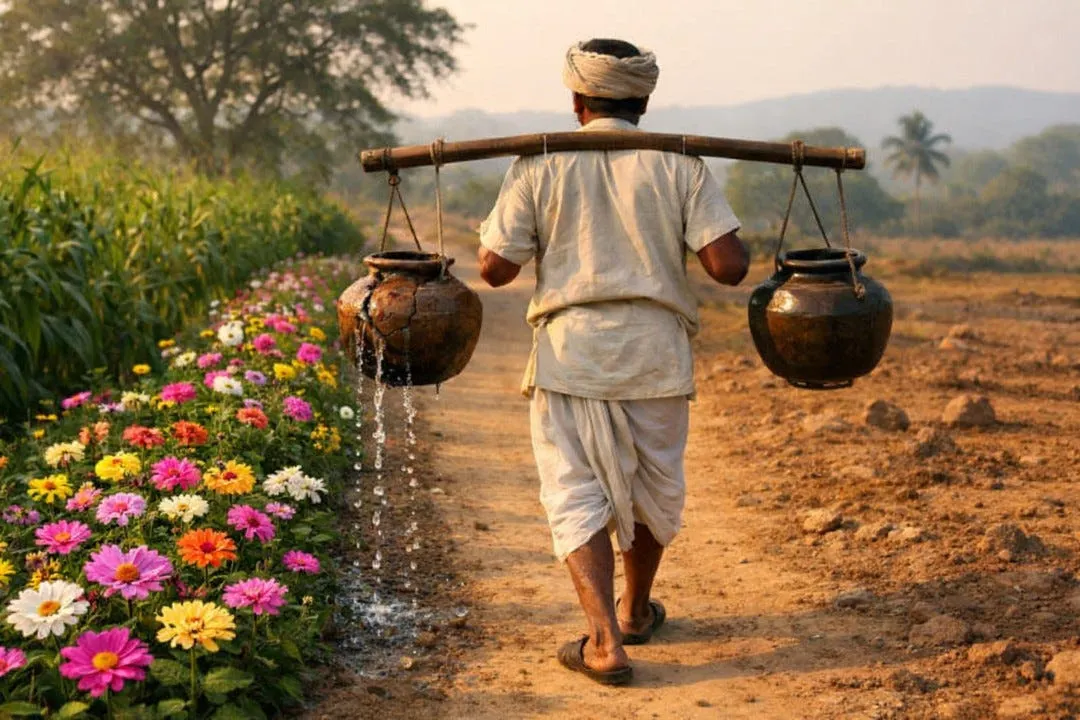
What is the best thing about getting older? In an old parable, a man carried two water jars suspended from a pole across his shoulders.

One jar was new and perfect; the other was old and cracked and leaked water along the path.

Every day, by the time the man reached his master’s house, the cracked jar was almost empty. The new jar boasted of its usefulness, while the cracked jar was ashamed of its flaws.

One day, the cracked jar said to the man apologetically:

“I am defective. I lose most of the water through my cracks before you reach the house.”

The man replied:

“Yes, but when was the last time you looked at your side of the path? I know all about your cracks, so I scattered seeds there. Every day, when you thought you were merely leaking water, you were watering flowers. Look at this road now!”

The jar looked and was amazed. His side of the path was covered with the most beautiful flowers imaginable.

“Because of you, the master always has fresh flowers on his table. Your cracks have leaked so much beauty into the world that people come from far away just to walk along this path. They say it fills them with joy like nothing else.”

Old age is the perfect time to leak beauty into the world. We think our cracks make us useless; nothing could be further from the truth. The older we get, the more wounds, flaws, and imperfections we carry — but these are the very cracks through which the light pours out.

Little do we know that someone has sown seeds along our path. These seeds can sprout only if we water them through our wounds. Our wounds are sacred. They are conduits of living water — unique life experiences that can nourish the seeds of new life.

Whole jars carry ordinary water; broken jars carry living water.

“One of the soldiers pierced Jesus’ side… bringing a sudden flow of blood and water.” — John 19:34

By that water, we have been healed. The mystery of healing is that it can come only through the Wound. The older we get, the more sacred our wounds become — and the more healing beauty we can spill.

For the world to flower, people must leak the beauty of their cracks. If we hide them or patch them up with tape, our beauty cannot flow out. When we hide our cracks, our path remains dry and barren. We become rigid and closed in on ourselves — crackpots rather than cracked pots.

When we open them, streams of living water gush forth, and everything begins to blossom.

We do not think much of old age. We think of it as diminishing. And it is diminishing — but in an enlarging way. As G. K. Chesterton put it:

“How much larger your life would be if your self could become smaller in it.”

— Orthodoxy


Learn to see differently with my latest book:

Why Do We Crave Adventure? Searching for the Yonder Star

Why do we crave adventure? Babushka: A Christmas Tale is a children’s tale by Dawn Casey. It’s a simple yet touching story about an old grandma who was busy tidying her home when a bright star shone in the sky.

Soon, three wise men knocked on her door. After she had fed them a hearty meal, they offered her a gift — an invitation to join them on their journey to find the newborn babe, the Prince of Peace.

Somewhat flustered, Babushka must have felt exactly like Bilbo Baggins on that memorable day when Gandalf nudged him out the door to join the dwarves on their adventure. And, like Bilbo, Babushka excused herself by saying she had dishes to do and floors to clean.

The next morning, she woke up to find them gone. To her utter surprise, an aching longing smote her heart. She realized she had made a terrible mistake.

Rushing out the door, she searched desperately, asking everyone she met if they had seen the three wise men. Yet, they were nowhere to be found. And so, as the story goes, Babushka is still wandering to this day — searching, asking, hoping… and giving gifts to anyone she meets.

The moral of the story?

When we choose comfort over adventure, we are always left with the residue of longing. The more we settle in our ways, the more painful the realization that we are missing out on something big and real. We see some people following the star and shrug our shoulders: “Fools. They are chasing after the wind.”

And yet, after they leave, we are overcome by an inexplicable yearning. It dawns on us that we have made a terrible mistake by NOT following the star — the call to adventure. We have been the fools; we have been chasing after the wind. We leap up and begin looking for those strange vagabonds.

We are looking for our “tribe” — those who follow the yonder star. We roam the world searching, looking into people’s eyes as if silently asking, “Are you going there too?” The greatest reward is when we find someone with the same glint in their eyes. They are looking for the same thing!

As Professor Digory Kirke said to the children at the end of The Lion, the Witch and the Wardrobe:

“Don’t mention it [your adventure] to anyone else unless you find that they’ve had adventures of the same sort themselves. What’s that? How will you know? Oh, you’ll know all right. Odd things they say — even their looks — will let the secret out. Keep your eyes open.”

And Dostoyevsky mused:

“Beauty is a terrible thing. God and the devil are fighting there and the battlefield is the heart of man.”

Beauty is a terrible thing because it is a call. It ignites a battle in our hearts. We long for it, and yet we resist it at the same time. But sooner or later, we hear a knock on the door. We open it and see strange but happy people with a glimmer in their eyes — the shimmer of the yonder star.

They eat and drink with us and invite us on an adventure. We think, “This is madness. I can’t leave like this — without my handkerchiefs, without first cleaning my floors.” But the next morning, the travelers are gone, and a thought strikes us like a lightning bolt:

“I must find them — now”!

And without another thought, we rush out the door.

How is a War Won?

How is a war won? Two years into the war, the chief psychiatrist of the Rehabilitation Center “Unbroken” in Lviv, Ukraine, said to the volunteers who wished to work 12-hour shifts:

“If you work yourselves to death for twelve hours a day, you’ll end up in the psychiatric ward as my patients.”

These people were driven by the most natural instinct we all feel in times of crisis — to prioritize duty over joy. When you see so much need and suffering around you, you think: “I will put off joy and first do what must be done.”

And yet, according to the Ukrainian philosopher Alexander Filonenko, this is a grave mistake. Those who make duty their first priority never truly fulfill it. Duty is never accomplished from a mere sense of duty. Those who try to “white-knuckle” adversity inevitably fail.

Interestingly, after the war began, bookstores in Ukraine quickly ran out of books by the Stoics. The common misconception about the Stoics is that they teach how to endure adversity through willpower. It is not true.

Stoicism is more about joy than willpower.

“The happiness of your life depends upon the quality of your thoughts.”
— Marcus Aurelius, Meditations 5.16

Stoicism is not so much about self-denial as about changing your thoughts. Stoics are not the stone-faced people. They’re those who actively work on changing their thinking.

“Men are disturbed not by things, but by the views they take of things.” — Epictesus

The only way to endure a crisis is to do the most counter-intuitive thing — prioritize joy over duty. The only way to survive hell is to keep enough visions of heaven before your eyes. Those who focus on duty never fulfill their duty. Those who focus on joy cannot help but fulfill it.

What do war-injured people need the most? Medical care? Supplies? Prosthetics? “UNBROKEN” answers: beauty. Beauty is the only force that revitalizes the soul and helps the body heal. It is the only power that can lift a person from the ashes. That is why UNBROKEN invites orchestras, ensembles, and individual musicians to perform for patients right inside the rehabilitation center.

So far, they have hosted the Academic Symphony Orchestra of the Lviv National Philharmonic, held various concerts connected to veteran and wounded-soldier rehabilitation, and, in one 2023 performance, classical musicians played beside wounded soldiers. And more continue to come.

To survive, one must thrive. Survival can never be achieved by aiming at survival. When our world crumbles, we must do the most counter-intuitive thing — turn our gaze to Beauty. Beauty is the only thing that truly “changes our thoughts.”

“The soul becomes dyed with the colour of its thoughts.” — Marcus Aurelius

What is the color of my soul today? It takes on the color of my thoughts — always. No war is won by endurance alone. It is won when I immerse my soul in the colors of joy and allow meaning to transform my thoughts.