

How Can We Truly Know Anything?

How can we truly know anything? In Poetic Diction, Owen Barfield argues that meaning is not static. When a logician attempts to fix the meaning of a term, it is inevitably reduced.

Try to define the word “home,” and you are left with something that is no longer much of a home. Try to define your spouse, and before long, you no longer have a spouse.

The meaning of “home” is revealed only to the one who dwells in it poetically. The meaning of “spouse” is revealed only to the one who dwells with them poetically.

According to Barfield, meaning emerges when the poet — maker in Greek — through inspiration, stumbles upon a fresh metaphor that stirs and shifts human consciousness.

“The poet’s relation to terms is that of a maker.” — Poetic Diction

In other words, unless I look at my spouse and allow a fresh metaphor to strike me unexpectedly, I reduce her to less than she is. But if I find the metaphor — or rather, if the metaphor finds me — the meaning will be revealed as a felt change of consciousness.

Modern consciousness recognizes only static meaning because it is bound to a particular lens — the lens of non-participation. That is why the modern world has so little meaning: such a view is inherently reductive.

It assumes that meaning can be grasped by definition, captured within an affixed description, as though it existed independently of the one who perceives it.

But there is no such thing as fixed, static meaning. The Logos of a thing is revealed only in between — in the living relation between myself and the thing. Meaning arises as I participate in it — through inspired metaphor.

The word “meaning” itself has a curious etymology. It comes from the Old English mǣnan, which means “to intend” or “to signify.” Surprisingly, the noun mean (as in Golden Mean) comes from a related Old English term “gemǣne.” Both mǣnan and gemǣne trace back to one common Proto-Indo-European root: mei- / moi-, which means to bind, unite, exchange, have in common.

In other words, meaning arises within a certain means — within a medium, in the shared space, in-between. Signification is revealed only through participation.

Barfield quotes Aristotle:

“The making of metaphors is by far the most important; since this alone does not involve borrowing from somebody else and is [therefore] a mark of genius; for to make a good metaphor is to contemplate likeness.” — Poetic Diction

A good metaphor is inspiration itself — it comes directly from the Spirit revealing the Logos. True metaphor doesn’t borrow anything from anyone; through imagination it ascends directly to God and is granted the gift of Mercurial speech.

Then, it strikes us with a magical wand of sound and shifts our consciousness to contemplate True Likeness. At that point, we no longer need definitions — we know.
What is the Significance of the Wave-Particle Duality?

What is the significance of the wave-particle duality? Wave-particle duality is truly fascinating. It’s where physics becomes poetry.

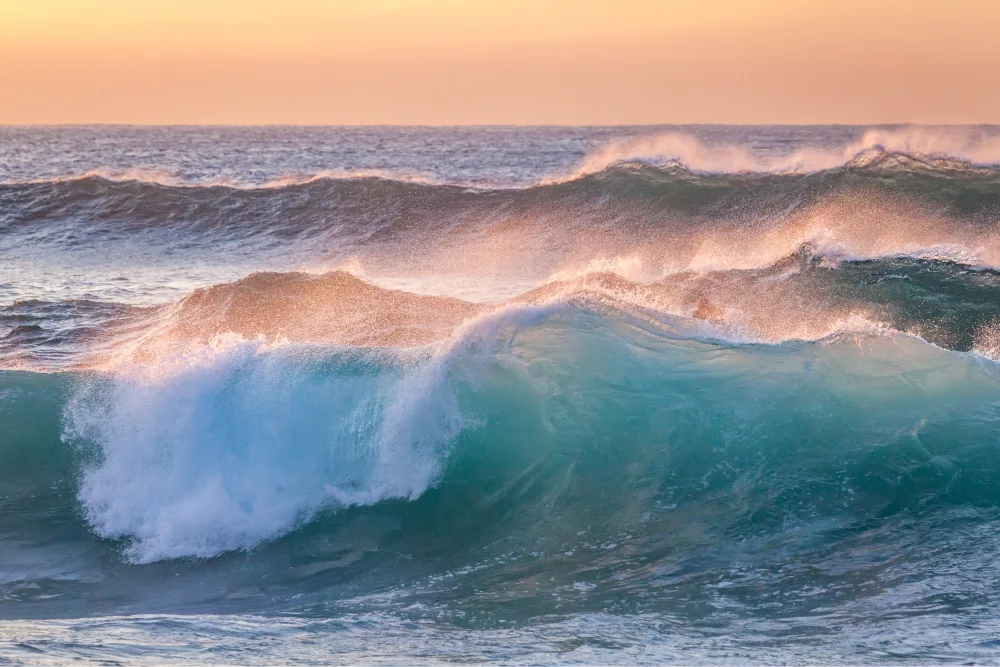
When we don’t observe an electron, it behaves like a wave; when we do, it behaves like a particle. Whatever we zero in on becomes discrete — turns into bits and pieces. Whatever we don’t observe behaves like a wave — Music. Why? Physics doesn’t answer that question. Poetry does.

Everything we zero in on becomes fragmented. The fallen mind perceives the world in bits and pieces. It wants to control by analyzing and manipulating. It believes that the whole equals the sum of its parts. It wants to understand the bits and pieces to control the whole. It fails. The Whole is always larger than the sum of its parts.

When we are focused on the parts, reality appears as discrete. It doesn’t yet show us what it is. When we stop zeroing in on its parts, it suddenly changes its behavior and becomes… Music. The Wave. It waves at us so we wake up from the illusion of control and attune to the Music of the Whole.

Is the world a particle or a wave? A particle when we observe it with a view to seeing its parts. And a wave when we stop looking for parts and look for participation. We no longer look at it but through it. The world becomes transparent. We see through it. It is no longer an idol. It is an Icon that reveals to us the mystery of the Whole.

The world is Music from the invisible realm incarnated in its many parts. When we stop looking for parts we begin participating in the Whole. We become artists. When an artist creates art, they may be looking at individual parts of the picture, but they must hear the Music of the Whole at all times — otherwise, no part will come out right.

All artists know that. You must hear the Music first, and then every stroke of your paintbrush will fall in its place. The Whole reveals to us the meaning of each part. We no longer zero in on the part itself to understand the Whole. We focus on the Whole to understand its parts.

When we start with participation, we understand every part. When we start with observing parts, we don’t understand even the parts. When we look AT the world, it is an idol. When we look THROUGH the world, it is an icon. We become perceptive of the Music from beyond the visible realm which gives meaning to each individual part. We realize the world is a huge Parable that opens up to us when we grok the Whole.

Werner Heisenberg said:

“Quantum theory provides us with a striking illustration of the fact that we can fully understand a connection though we can only speak of it in images and parables.”

And Albert Einstein:

“The most beautiful thing we can experience is the mysterious. It is the source of all true art and science.”

Our gaze is magical. If we look to see parts, we will find them. Our gaze will create them. If we look to catch the Wave, we will. When we catch it and ride it, we will participate in the Great Music, and everything around us will become a Parable.

“Don’t you understand this parable? How then will you understand any parable?” Jesus in Mark 4:13