Do The Valar Have Gender And Why?

Do the Valar have gender and why? In The Silmarillion, the Valar — the spirits of Ilúvatar through whom the visible world was made — are male and female. But how can spirits have gender?

Each Vala chose a bodily form, male or female, according to the “difference of temper they had even from their beginning.”

“But when they desire to clothe themselves, the Valar take upon themselves forms, some as of male and some as of female. For that difference of temper they had even from their beginning, and it is but bodied forth in the choice of each, not made by the choice, even as with us male and female may be shown by the raiment but is not made thereby.”

Since the Valar are described as “the offspring of Ilúvatar’s thought,” does this mean that divine thoughts possess an innate gender?

This seems to align well with the curious fact that, in many languages, words have grammatical gender. In Russian, for example, every noun has grammatical gender, and adjectives and past-tense verbs agree with it. A table (стол) is always masculine. A cat (кошка) is always feminine. And so on.

Even in languages that lack grammatical gender for nouns, such as English, gender is often implied. A ship, for example, is traditionally referred to as “she.” The sun is a “he.”

According to Tolkien, the Valar chose their “raiment” based on what had already been in them from the beginning. Their gender was bodied forth by their particular choice — not made by it. Gender seems to be an innate characteristic of God’s thought.

Divine thoughts are not neutral. They possess innate gender polarity — a potential for bearing fruit. It is this gender polarity, inherent in every thought, that engenders the current of life. The Valar’s gender corresponds to the kind of energy each of them brings into the world.

What is gender polarity? Gender polarity is a mode of God’s self-revelation in the world. God reveals Himself as the Trinity — One in Many, Unity in Multiplicity. He is not just Unity, and He is not just Multiplicity. He is a constant tension between oneness and otherness.

The Trinity is a never-ending dance between One and Many, Likeness and Otherness. The Persons of the Trinity are One and yet totally Other. When God brings Eve out of Adam, He creates the perfect Other. By becoming Adam’s “other,” she is like him and yet totally distinct from him.

The result is life-engendering polarity — a perfect reflection of the dynamic within the Trinity itself. Adam and Eve were to engender life just like the Trinity engenders life within itself. The Trinity engenders life as a tension between Oneness and Otherness.

Each Person of the Trinity exalts and glorifies the Other. Each makes the Other as distinct as possible. Yet the more distinct they become, the more deeply united they are. And the more perfectly one they are, the more fully they reveal their otherness. Life springs from this paradoxical union of oneness and otherness.

Oneness without otherness is sameness. Sameness is sterile. Only polarity between oneness and otherness is fruitful. Life is engendered wherever likeness and difference meet. To engender life, I need someone who is like me, yet not me.

Each thought of God is “gendered” — that’s why each divine thought/breath is fruitful. Each bears within itself a unique potential, a particular form of oneness and otherness. Heaven and earth are one, yet utterly other. Their union engenders life.

Even as I write these words, my own thoughts are “gendered” as well. If they are to give birth to meaning, I must catch how the seemingly disparate thoughts intertwine into one beautiful pattern. I must discover likeness within otherness, oneness in otherness, as I weave a tapestry of words from a palette of diverse impressions.

Gender is the mystery of divine fruitfulness. God is the Sower. He sows thoughts. And His thoughts are “gendered.” His thoughts are either seeds or wombs. Some are from heaven, some from the earth. Some carry male energy, some female.

Like the Valar in The Silmarillion, they enter the world to shape it and prepare it for the coming of the Firstborn. And so their great labors begin. The Valar saw that…

“…the Great Music had been but the growth and flowering of thought in the Timeless Halls, and the Vision only a foreshowing; but now they had entered in at the beginning of Time, and the Valar perceived that the World had been but foreshadowed and foresung, and they must achieve it. So began their great labours…”


Read more about The Silmarillion and other related topics:

What Does Saruman of Many Colors Mean?

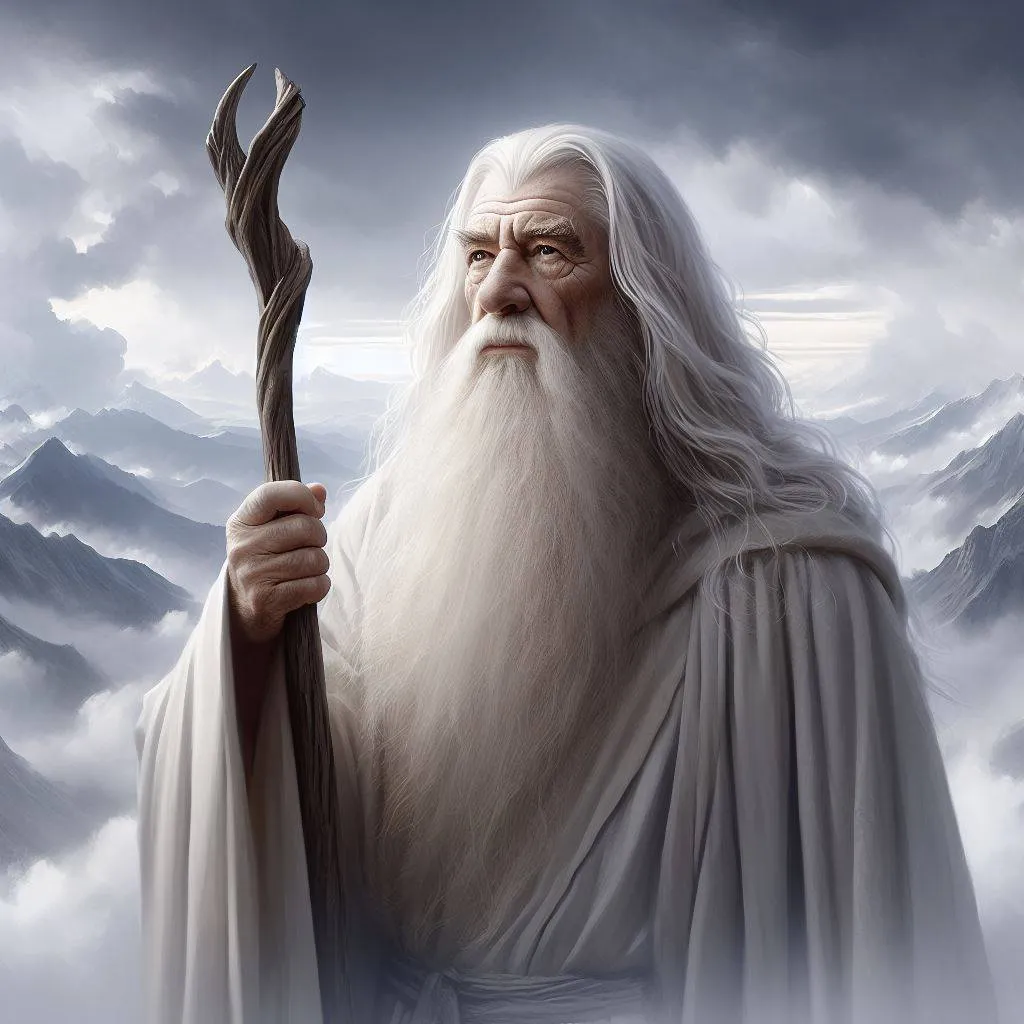
What does Saruman of many colors mean? Saruman the White was white up to a point. Beyond this point, he only “seemed” white. He said to Gandalf in Orthanc,

“I am Saruman the Wise, Saruman Ring-maker, Saruman of Many Colours!’’

When Gandalf looked, he “saw that his robes, which had seemed white, were not so, but were woven of all colours, and if he moved they shimmered and changed hue so that the eye was bewildered.”

The white that he once was had been broken into many colors. He was now the “rainbow Saruman.” Saruman believed in breaking things to find out what they were. He believed this would give him power. According to Gandalf, he strayed from the path of wisdom,

“And he that breaks a thing to find out what it is has left the path of wisdom.”

When you want to know what something “is,” you can’t break it. You must encounter it as a Whole. Being is holistic. It’s not breakable. It’s not reduceable. A thing that is cannot be less than it is. To know the White one must encounter the White, not break the White into many colors.

For Saruman, the White was only the beginning. He wanted to “use” the White for his purposes. He wasn’t interested in “knowing” the White; he was interested in “using” the White. What you want to know you can’t break. What you want to use you can’t help breaking.

‘‘White!’’ he sneered. ‘‘It serves as a beginning. White cloth may be dyed. The white page can be overwritten; and the white light can be broken.’’

Gandalf wisely retorts,

‘‘In which case it is no longer white.”

A broken white is not white. A whole white is not a thing to be used but a living reality to participate in. Participation is the highest wisdom. Gandalf knew it in his gut. He learned it from Nienna herself, the Queen of Pity when he was her pupil in times immemorial when his name was Olórin. From Nienna, he learned patience and compassion.

He praised Bilbo for showing compassion to Golum — knowing that he had a part to play in the Whole, for better or worse. He trusted that the Hobbits would destroy the One Ring because he had perceived their part in the Great Music. He had learned to be patient and wait for the Whole to unfold. That’s why he became Gandalf the White — or Saruman as he should have been.

Later, Tolkien would write in his Mythopoeia,

Man, Sub-creator, the refracted light
through whom is splintered from a single White
to many hues, and endlessly combined
in living shapes that move from mind to mind.

The White can either be broken or refracted. When broken and used, it ceases to be white. When refracted to be encountered, it remains the Living White — and creates a symphony of colors. When we encounter the Living White, it passes through us and gets refracted to many hues without being diminished.

Everyone who participates in the Living White shines with refracted light. They become sub-creators, each refracting the White in his or her own way.

Melkor’s Lies: How to Remove the Fear of Death

Image Courtesy

How to remove the fear of death? Speaking of the beginning of days, The Silmarillion says that Ilúvatar gave Men “strange gifts.” First, he set eternity in their hearts so they would always desire to go beyond the visible world:

“But to the Atani I will give a new gift.’ Therefore he willed that the hearts of Men should seek beyond the world and should find no rest therein; but they should have a virtue to shape their life, amid the powers and chances of the world, beyond the Music of the Ainur, which is as fate to all things else.” The Silmarillion

Second, he gave them a gift of finiteness.

“Death is their fate, the gift of Ilúvatar, which as Time wears even the Powers shall envy.”

But what is there to envy? Why would even the Valar envy Men? It turns out that in the beginning, Men didn’t fear death. Fear of death was instilled into their hearts by Melkor who deceived them by saying that it was Iluvatar’s punishment rather than a gift.

“But Melkor has cast his shadow upon it, and confounded it with darkness, and brought forth evil out of good, and fear out of hope.”

Melkor’s shadow had a name; its name was Ungoliant—a monstrous spider born out of his envy. She was neither an Ainur nor Maiar. Most likely, she was Melkor’s Shadow-Self, his own insatiable darkness, which he feared. It was Ungoliant who first spun a spiritual darkness called Unlight, for it was made in mockery of light.

“The Light failed; but the Darkness that followed was more than loss of light. In that hour was made a Darkness that seemed not lack but a thing with being of its own: for it was indeed made by malice out of Light.”

The darkness that existed before was not a spiritual darkness—it was merely an absence of light. That first darkness was part of a good creation. When the Elves awakened at the Bay of Cuiviénen, they beheld the stars of Varda in the night sky for a long age. There was nothing scary about it. Light and darkness were but paints in the hand of Iluvatar.

Ungoliant infused the first darkness with malice, filling it with “nets of strangling doom.” She cast Melkor’s shadow on it. Darkness became a source of existential fear. Later, Melkor cast his shadow upon the gift of Iluvatar—Man’s mortality. He deceived Men into believing that death was not a gift but a doom, and they started craving immortality. Eventually, they decided to seize it by force, which led to the fall of Numenor.

Melkor impressed upon the hearts of Men that death was a punishment—a severing from Iluvatar. Distorted by Morgoth’s lies, death became a mockery of God’s gift—Men’s ability to leave the Circles of the World and be renewed. While the Elves were bound to the fate of the world, growing weary of its unending cycles, Men were granted the grace to depart and be renewed.

In the beginning, there was no more fear in dying than in falling asleep. Men knew they would get up “in the morning” refreshed. They simply let go of their consciousness and slept, until newness, freshness, rest, restoration, and hope overtook them.

Curiously, most people who have had a near-death experience report that after their return, they no longer fear death. A friend of a friend—who died of a brain tumor, saw heaven, and returned after being miraculously healed—says she doesn’t fear dying anymore. She says, there is no death. You don’t even lose consciousness.

“What struck you the most in Heaven?” asked the person who interviewed her. She answered, “That God is a Sound—an ineffable and irresistible Sound that you hear everywhere: in all things, in others, and in yourself.”