
What is the Hidden Message of Groundhog Day?

What is the hidden message of Groundhog Day? I would never have thought there was something in Groundhog Day that I didn’t know. I thought I knew the movie by heart. Apparently, I didn’t. To memorize something means to commit it to memory; to learn something by heart means to commit it to the heart.

As my wife and I watched the first few minutes of the movie last night, she suddenly asked, “Why is the groundhog’s name Phil — just like Phil Connors?” Her question sent me reeling. How could I have missed it? Yes! Phil Connors is Punxsutawney Phil. He is the groundhog of the story.

According to Pennsylvania Dutch legend, if a groundhog emerges from its burrow on February 2 and sees its shadow, it retreats into its den and winter lasts six more weeks. If it does not see its shadow, spring arrives early.

Phil Connors is a weatherman—but he is under the weather. He’s fed up with people. He is under his own shadow, though he is unaware of it. His skies are overcast 24/7. Rita and Larry try to pull him out of his shadow, but he always retreats into his den. People drive him nuts — and into his “den.”

When you are under the weather, people always drive you nuts. You want to retreat, withdraw, and languish quietly under the weather of your own exclusivity. Your shadow grows large and frightening. You want to hide. Everyone with a big shadow has a den to hide in — from himself and from others. The shadow is a scary thing.

How do you get out of it?

Spiritually speaking, my shadow is always there until I become aware of it. It remains until I realize its presence. The moment I see it, it is gone. When I become aware of my own shadow, I look behind me and do not see it. My spring has come.”

Phil’s shadow is enormous. He hates his job, he hates his circumstances, he hates people. And like Punxsutawney Phil, he retreats into his “den” to get away from it all. He is not yet aware of his own shadow even though he lives under it 24/7.

So he hides from himself and from others. His “den” is his Groundhog Day. He is trapped in his den — in his own shadow — locked in a vicious circle. How do you escape your own shadow?

All vicious circles are broken the moment we die. All shadows are trampled down by death to self. The Paschal hymn —“Christ trampled down death by His own death”—carries profound spiritual wisdom. It foreshadows the death of the shadow.

Phil remains stuck in his “den” — February 2 — until he becomes aware of his shadow and agrees to die to himself. He passes through the vicious cycles of his own Inferno and Purgatory until, One Day, he finally lets go. The next morning he wakes up — and there is no shadow. It is gone! His spring has come.

Phil Connors is a “weatherman under the weather” who is unaware of his own shadow. That shadow binds him in a vicious cycle of misery until he recognizes it and… releases it.

The moment we die to ourselves, we are freed from the shadow. A new day dawns. And it is February 3. Spring is coming.


Was King Arthur Real or a Legend?

Was King Arthur real or a legend? Has there ever been such a thing as a sane king? Surprisingly, yes. Otherwise, how could we have imagined such mythic figures as King Arthur, Aragorn, or others like them?

In his essay On Fairy Stories, Tolkien suggests that historical Arthur was “thrown into the Pot” of myth-making and boiled there until he emerged as a King of Faerie.

“It seems fairly plain that Arthur, once historical… was also put into the Pot. There he was boiled for a long time, together with many other older figures and devices, of mythology and Faerie, and even some other stray bones of history… until he emerged as a King of Faerie.”

There must have been enough myth in the historical Arthur to justify his becoming the Arthur of legend. Others must have seen something in the man which they later wove into Myth. And one thing the legends continually emphasize is that Arthur never strove for power.

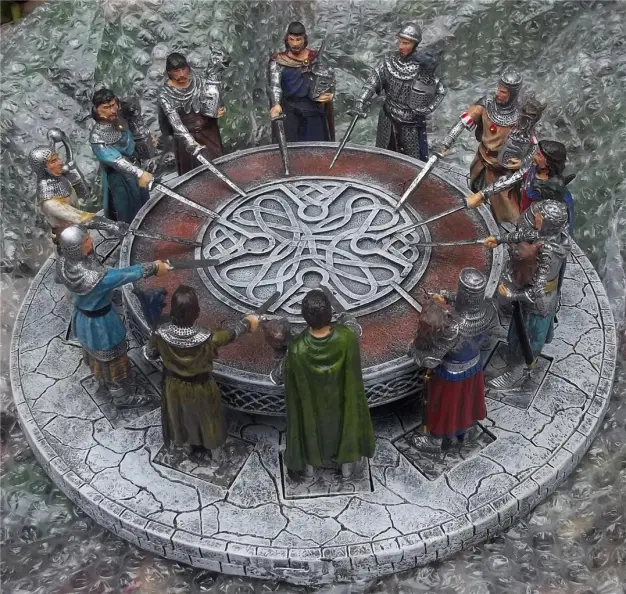
The whole idea behind the Round Table was so that no one — not even the king — would sit at the “head.” The Round Table has no head. It is both Altar and Equalizer: no one presides because everyone is there to offer himself as a sacrifice. But why would Arthur willingly share power?

The answer to this question is just as mythical as the question itself: Arthur knew he wasn’t adequate to rule. That’s why he needed others. A king is only sane if he believes himself inadequate to rule.

C.S. Lewis captured this idea beautifully in The Magician’s Nephew. When Aslan told Frank and Helen that they would be the first King and Queen of Narnia, Frank replied:

“Begging your pardon, sir,” he said, “and thanking you very much I’m sure (which my Missus does the same) but I ain’t no sort of a chap for a job like that. I never ‘ad much eddycation, you see.”

Aslan asked him if he could do the usual things a king would do, and Frank replied,

“Well, sir,” said the Cabby very slowly, “a chap don’t exactly know till he’s been tried. I dare say I might turn out ever such a soft ‘un. Never did no fighting except with my fists. I’d try – that is, I ‘ope I’d try – to do my bit.”

”Then,” said Aslan, “You will have done all that a King should do.”

There are many people in the world who believe they are ready to be kings. They believe they can rule. But that certainty is the surest sign they cannot — and there is something that rules over them. Sanity is a sensation of being connected to a Power greater than you. You draw your sense of adequacy from Another.

If you feel you are enough, you are not. If you know you are not enough, you are. True kings are keenly aware of their inadequacy to rule. The most insane rulers in history are those who believe they can and should rule. The best of rulers always share power.

They believe in a Higher Power. That’s why they don’t build square tables — they don’t need to preside. They build round tables — a place where they can offer themselves for others who rule together with them. Sanity is a matter of accepting your own powerlessness and realizing that you are not helpless.

There’s a Greater Power than you on which you can rely. Powerlessness and helplessness are not the same; in fact, they are direct opposites. Those who feel powerful are truly helpless. Those who admit their powerlessness are never helpless. If you say: “I ain’t no sort of chap for a job like that,” you will receive all the help in the world.

When you are certain you can, you can’t. When you confess you can’t, you can. Just look around you, and you will see mighty princes and princesses around your Table — the rulers who are ready to lay down their lives for you. With their eyes upon you, you will find the courage to rise and fulfill your calling.”