
What did Carl Jung say about suffering? The larger our ego, the less likely we are to change without suffering. Ultimately, it is the ego itself that generates and multiplies suffering. According to Carl Jung, suffering arises in the soul when we try to inflate the ego instead of dealing with the shadow.
“Neurosis is always a substitute for legitimate suffering.” — Carl Jung
The paradox of the ego is this: when we try to escape legitimate suffering — the pain we must go through to embrace our shadow — by boosting the ego, we increase our own suffering.
This is the story of the Prodigal Son. He fled his home to escape himself. He thought he could escape his shadow through reckless living. In his desperate effort to outrun his own shadow, he only succeeded in generating a mountain of unnecessary suffering.
And yet, paradoxically, that very self-inflicted and “unnecessary” suffering proved to be necessary after all. It brought him to his senses. It awakened him.
“The privilege of a lifetime is to become who you truly are.” — Carl Jung
Those with an inflated ego rarely change unless the ego is forced to endure the suffering it has brought upon itself.
“There is no coming to consciousness without pain.” — Carl Jung
The AA Big Book recounts the story of an American businessman who, after years of trying unsuccessfully to stop drinking, traveled to Europe to get a consultation from Carl Jung. He completed his treatment with remarkable confidence: physically and mentally restored, and convinced he now understood his mind so deeply that relapse was impossible.
Yet before long, he was drunk again. He returned to Jung and pleaded for the whole truth. The doctor told him:
“‘You have the mind of a chronic alcoholic. I have never seen one single case recover, where that state of mind existed to the extent that it does in you.’ Our friend felt as though the gates of hell had closed on him with a clang.” — (AA Big Book, page 27).
Paradoxically, this became the moment of the gentleman’s awakening. He recovered and lived a sober life. It was the “clang of the gates of hell” that changed him. Often, it is precisely such a clang — the total collapse of illusion — that shatters an overinflated ego.
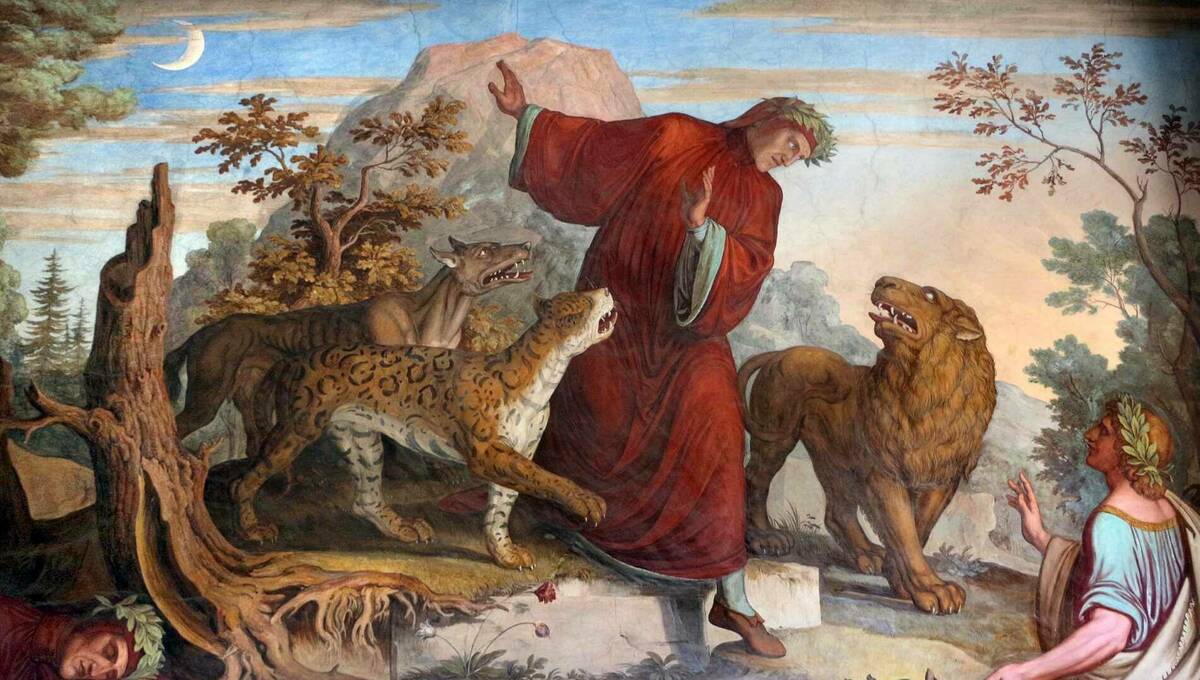
That lowest point is the pivot. It is there that we cry “Miserere,” with Dante Alighieri, who found himself “in the dark wood,” confronted by the three beasts — his own shadow made visible.
When we realize we cannot overcome our own beasts, we cry out for help. In that moment, our ego shatters — and we are saved. It is the point of coming to our senses, of returning home.
Here, all “unnecessary” suffering comes to an end. Guides appear out of nowhere, leading us into our Inferno to confront our shadow. Little do we know that descending is also ascending. By journeying into our personal hell, we simultaneously rise toward Purgatory and Paradise.
The moment we come to our senses, we know we have a home and a Father. We drop the pig’s food we have been eating and follow the Guide.