How Do You Recognize God?

How do you recognize God? Alexander Filonenko, a Ukrainian philosopher, once shared a story about an exhibition dedicated to the New Martyrs, who were killed under the Soviet regime during the 20th century.

The people involved in preparing the exhibition discovered something surprising: the icons of the New Martyrs, painted from photographs taken shortly before their execution, failed to capture what the faces in the photographs so clearly expressed.

The icons didn’t do justice to the light in the eyes of those condemned to death. Usually, it’s the other way around: an icon captures the invisible light in a saint through exaggerated proportions, altered dimensions, and even reverse perspective.

Yet, something essential was missing from the icons that was clearly present in the physical faces of the martyrs.

How do you recognize a saint? By the halo? By an especially spiritual expression? By an elongated figure reaching toward heaven? Or by something elusive, something that cannot quite be grasped, since outwardly a saint looks just like everyone else — except for a strange yet irresistible flicker in their eyes.

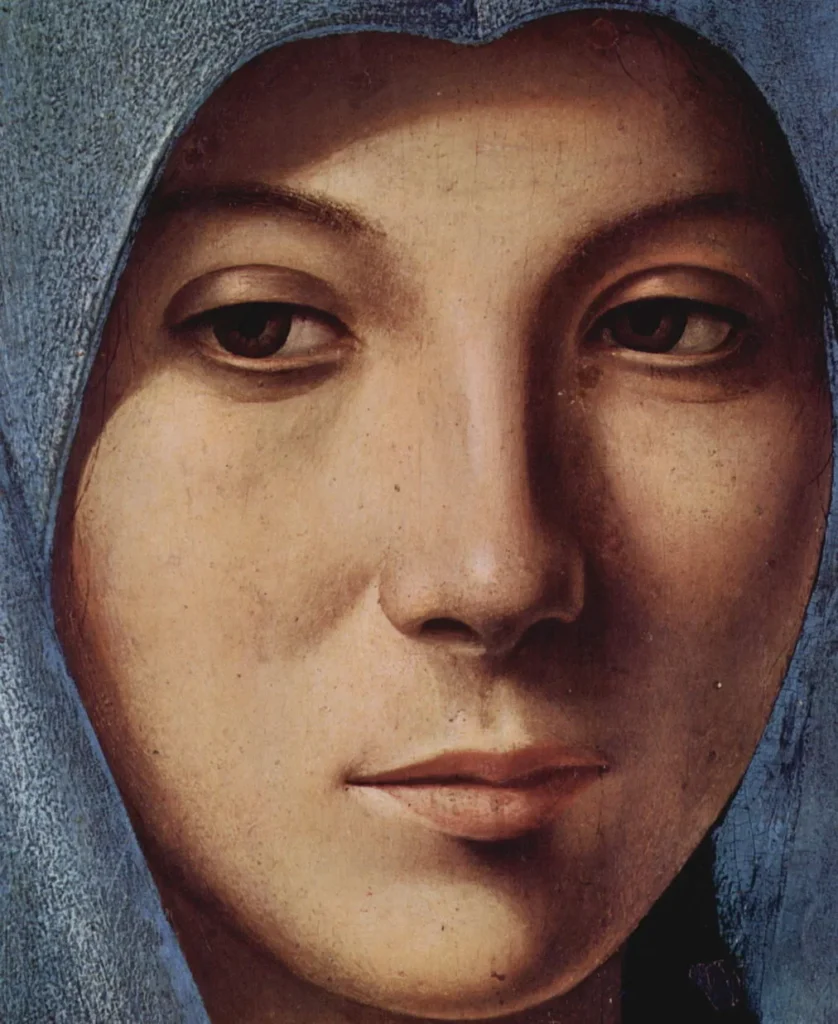
This is what Antonello da Messina, an early Renaissance painter from Italy, must have sensed when he depicted Mary, Jesus, and the saints in a strikingly realistic manner, contrary to the conventions of his time. Saints were traditionally portrayed with halos above their heads.

Yet when we see them in the middle of the street, we see no halos. We see their eyes. Antonello da Messina made the eyes the focal point of his paintings. He sought to show not how different Jesus and Mary were from us, but how strikingly similar they were.

They could have been anyone we meet on the street. What if God was one of us? Just a slob like one of us. Just a stranger on the bus, trying to make his way home…

After all, didn’t God become one of us so we can become like Him?

Recognition of God is always a matter of capturing something elusive that shines through a person’s ordinary features.

God wants to become like us so that we may become like Him.

When we fail to recognize Him in a stranger on the bus, we fail to recognize Him at all.

There is nothing extraordinary about God — unless we recognize the extraordinary in the ordinary. We can only grasp how unlike us God is by first recognizing how much He is like us. We can only appreciate His transcendence when we discover His immanence.

Only when we recognize how intimately approachable He became can we begin to see how infinitely unapproachable He remains.

God cannot be recognized as God unless He is first recognized as man.

After all, the Roman soldier who looked at Jesus on the cross didn’t see any halos. He saw something else and said:

“Truly this man was the Son of God.”


Explore the connection between Beauty and recognizing God in my book:
How Did C.S. Lewis Define Friendship?

How did C.S. Lewis define friendship? He writes:

“I have no duty to be anyone’s Friend and no man in the world has a duty to be mine. No claims, no shadow of necessity. Friendship is unnecessary, like philosophy, like art, like the universe itself (for God did not need to create). It has no survival value; rather it is one of those things which give value to survival.” — C.S. Lewis

Friendship is something we can live without but not something worth living without. If life is reduced to mere survival, there’s little value in life. Our bios — biological life — means very little without zoe: life in its fullness.

According to C.S. Lewis, to possess Zoe — true life — we absolutely need the things we can absolutely do without.

Friendship begins only when I encounter someone I have no need for in order to survive — and they have no need for me either. We become friends the moment I discover that they genuinely share my sense of wonder.

“The typical expression of opening Friendship would be something like, ‘What? You too? I thought I was the only one.’” — C.S. Lewis

Philosophy, friendship, and art are not born of necessity but of wonder. We can do without them but life loses its zest. The paradox is this: to experience life as zoe, we must move beyond life as bios — beyond mere necessity. Zoe comes only to those whose mind is free from the cares of the world. Zoe is the fruit of rising above dutiful living.

Philosophy, art, and friendship do not survive in our hearts when our goal is survival. When we live under the shadow of necessity, philosophy, art, and friendship wither because they appear worthless.

To survive both physically and spiritually, we need things that give value to survival. Historically, philosophy, art, and friendship have flourished the most in the darkest of times.

Boccaccio began lecturing on the Divine Comedy in 1373, not long after Europe had been devastated by the Black Death. Many historians see this period as the dawn of the Renaissance. In dire straits, people deeply sense that bread is not enough for survival.

They instinctively reach out for the unnecessary things like philosophy, art, and friendship. They need a reason to live more than the means to live. Bios cannot give you a reason to live. Zoe can. Paradoxically, when people struggle simply to survive, they eventually discover that survival itself depends on something beyond survival.

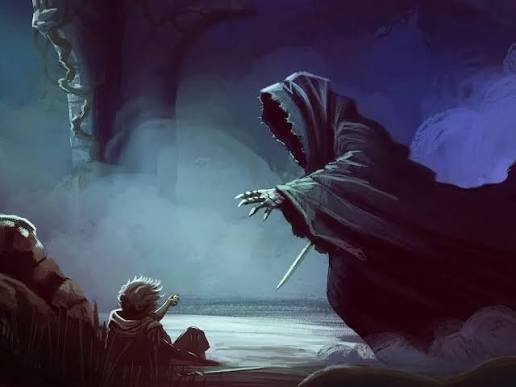
After Frodo was wounded by the Black Riders, his friends carried him toward the Ford of Bruinen. He was slipping into the world of shadows. Cold, exhausted, and overwhelmed by despair, he struggled against the growing darkness. Yet something within him enabled him to resist evil. What?

“Frodo… had time to gaze ahead and to think. He recalled Bilbo’s account of his journey and the threatening towers on the hills north of the Road, in the country near the Trolls’ wood where his first serious adventure had happened. Frodo guessed that they were now in the same region, and wondered if by chance they would pass near the spot.”

As they drew near Trollshaws, Frodo found himself thinking more and more about Bilbo’s adventures. His hand was lifeless, his body was shivering with cold, and yet, the bright light of Bilbo’s stories flooded his mind with light. Finally, as they bumped into the three stone trolls, everyone recalled his family history and laughed.

“They all laughed. Frodo felt his spirits reviving: the reminder of Bilbo’s first successful adventure was heartening.”

Frodo would never have made it if his friends and family didn’t give him enough reason to live. Frodo’s resilience to evil was rooted in the most unnecessary things in the world, like friendship, philosophy, and art.

What is the mystery of friendship, philosophy, and art? All three arise from Wonder. A heart alive with Wonder is wonderfully alive. When crisis hits, we survive only by reaching for what lies beyond survival.


Read more about the value of philosophy, friendship, and art: