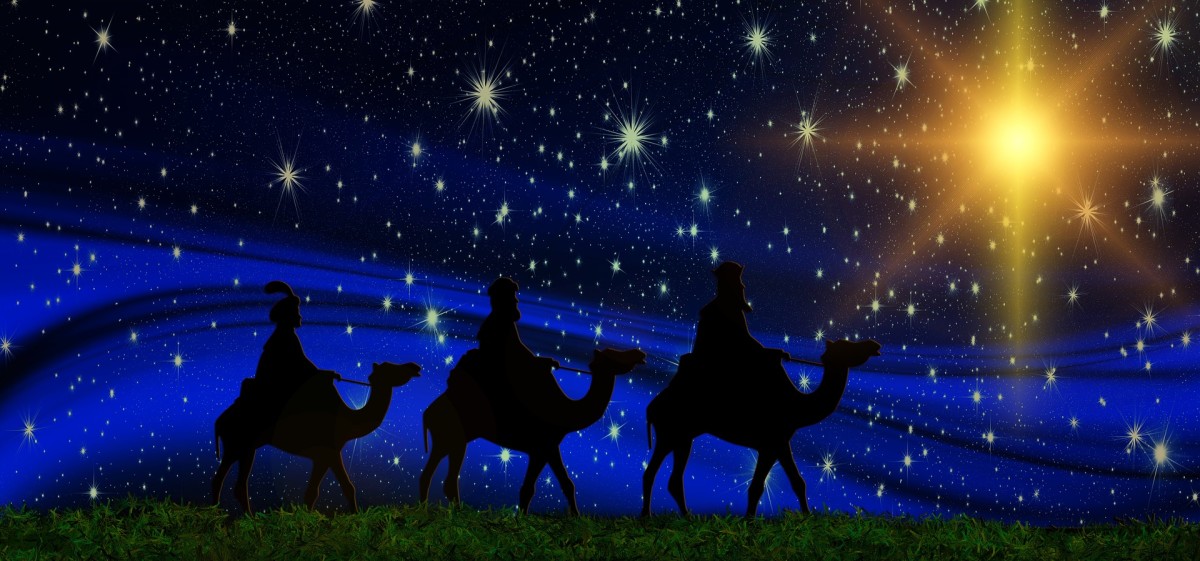
What is the True Significance of Pilgrimage?

What is the true significance of pilgrimage? “Where are we really going? Always home.” — Novalis

The history of mankind is the history of leaving and returning. We always go there and back again. Never only there — always there and back again.

Somehow, we all know that if we stay at home, without The Adventure, we will never become who we are. We need the Road, the Way. We must find the “golden child” within — using Jung’s archetype. The road goes ever on and on, down from the door where it began, and it is a road “there and back to yourself.”

Any road can become a way back to yourself — if you recognize it as The Way, the Tao. People step out the door because of an inexplicable yearning, an inner urge. Whether I go to Tahiti, Yellowstone, or a park across town, I don’t really go to a place — I go to a person: back to myself.

Hermann Hesse wrote in The Journey to the East:

“Each man had only one genuine vocation — to find the way to himself.”

In the wake of World War I, Hesse became keenly aware of pilgrimage as the only way a person can remain sane in an insane world. We are all pilgrims, following yonder star. We caught a glimpse of it amid the fray, chaos, confusion, and disillusionment of our hope-shattering times.

It calls us by its otherworldly light to go and look for the Child. But how do you tell of such a journey? Hesse’s allegory The Journey to the East captures his uncanny experience of pilgrimage to the “Land of the Morning Star” — his quest to remain spiritually alive in a world gone mad.

What do we need in order not to go mad with the world, which Jung described as undergoing a “collective psychosis”?

According to Hesse, we need to rememberTo recall the star we once saw and set out on pilgrimage. The way to the star is The Way. There, on the boundless stretches of time and space, we will encounter the real and the mythical alike. We will meet Melchior, Balthasar, and Caspar — the Magi — who saw the star too and embarked on the same journey.

“For our goal was not only the East, or rather the East was not only a country and something geographical, but it was the home and youth of the soul, it was everywhere and nowhere, it was the union of all times.” — Hermann Hesse, The Journey to the East

The Pilgrimage is something we yearn for and yet fear the most.

“It’s a dangerous business, Frodo, going out your door. You step onto the road, and if you don’t keep your feet, there’s no knowing where you might be swept off to.” — Bilbo Baggins

Bilbo secretly longed for The Journey. Gandalf’s nudge out the door was not an act of forcing — it was the awakening of Bilbo’s own dreams: the desire to go there and back again. Bilbo had glimpsed “the star” before. He remembered its mysterious call — and he hated himself for not following it.

Deep down, he knew that the worst tragedy under the sun is not to go on a journey.

Hesse writes:

“Once in their youth the light shone for them; they saw the light and followed the star, but then came reason and the mockery of the world; then came faint-heartedness and apparent failure; then came weariness and disillusionment, and so they lost their way again, they became blind again. Some of them have spent the rest of their lives looking for us again, but could not find us. They have then told the world that our League is only a pretty legend and people should not be misled by it.”

To see the Star is a dangerous thing — it calls us back to ourselves. The world tells us it is “a pretty legend,” nothing more, but the heart tells a different story. The heart yearns for nothing less than to become a Pilgrim and join the League.
What is True Literacy?

What is true literacy? For the ancients, writing was never something abstract; it was always tangible — engraved in living matter like bark, wood, clay, or stone.

They saw writings in the very phenomena of the world. The idea of using letters to record thought arose from observing the writings already “engraved” in creation. All things are letters — messages inscribed by the divine hand. They contain invisible script.

Interestingly, the word book is etymologically rooted in the Proto-Germanic bōk, which in turn derives from the Proto-Indo-European bhāg(ó) or bhōg, which means beech tree.

In essence, a book is a tree. Why such an association? Is it because the first writing tablets in Europe were made from thin slices of beechwood? Or it is because the ancients intuited a spiritual kinship between the book and the tree?

When you see a message etched into matter, you begin to associate the matter with the message — the visible with the invisible, the word with the wood that bears it.

The entire concept of literacy was born from reading the “letters” written upon every part of the universe. You see divine letters in a beech tree, and the letters become the beech tree.

The Russian word for beech tree (бук) sounds like the English “book.” The etymology of this word is, surprisingly, similar to the English book.

Moreover, the Russian word for letter — буква — is etymologically related to бук, the beech tree. Letters, writings, and books are all trees. And books, like trees, have leaves — leaves that tell our story.

In Tolkien’s Leaf by Niggle, Niggle the painter spent his life working on a single leaf. That leaf was the story of his life; it embodied his life. Little did he know that somewhere there was a Tree — and his leaf was part of it. The story of his life literally rustled in the leaves of an invisible Tree. One day, beyond death, Niggle finally saw it — his Tree.

While he worked on his leaf — his story — that story was quietly becoming a Tree. Every brushstroke, every hesitation, every inspiration was mysteriously linked to the leaves of his own Tree — the Book of His Life. We all have such Trees — our stories whispering in the unseen forest of heaven. Whether written in a book or not, the leaves of our lives already rustle on an invisible Tree that we shall one day behold.

To live in the world means to walk upon letters. Letters are everywhere, whether we notice them or not. Every stone bears its Ten Commandments — whether we can read them or not. Every beech tree is etched with the message of the Ultimate Mystery. It cries: “Under me!”

In The Silver Chair, Jill and Eustace came to a wall of rock where, cut in great letters, were the words UNDER ME. It was a sign — a message of Aslan clad in stone — calling them, as every letter of the world still calls us, to look beneath the surface and find that which lives under the visible.

As the Apostle Paul said to the Corinthians:

“You yourselves are our letter, written on our hearts, known and read by everyone.” — 2 Corinthians 3:2-3

We are letters. We are walking books — and walking trees. We embody a message. We are beech trees etched with divine inscriptions. Our leaves tell a story — our story. Our stories wave and rustle in the wind of the Spirit, who keeps writing His tale upon us.

When we look into one another’s eyes, we are reading — and being read. People are books, and books are trees. In every gaze, we hear the whispering leaves of the Book of Life.

Scripture and Nature are not two separate revelations; they are one. Nature is Scripture written in living matter. Just look underneath — and you will see a book of divine letters unfolding before our eyes, where every tree, every face, every breath becomes divine Speech.

He looked up and said, “I see people; they look like trees walking around.” — Mark 8:24

What is the Problem with Ideologies?

What is the problem with ideologies? Alexey Losev, an early 20th-century Russian philosopher, philologist, and culturologist, was one of the few Orthodox intellectuals who openly criticized Marxism as a modern myth — and managed to survive Stalin’s era without being executed. He was arrested in 1930 and sentenced to ten years of hard labor at the Belomor Canal camp.

In The Dialectics of Myth, Losev exposed the glaring inconsistency in the Bolsheviks’ view of myth and religion. They mocked ancient mythological and religious consciousness as primitive, yet relied heavily on mythological and religious symbols for their own purposes.

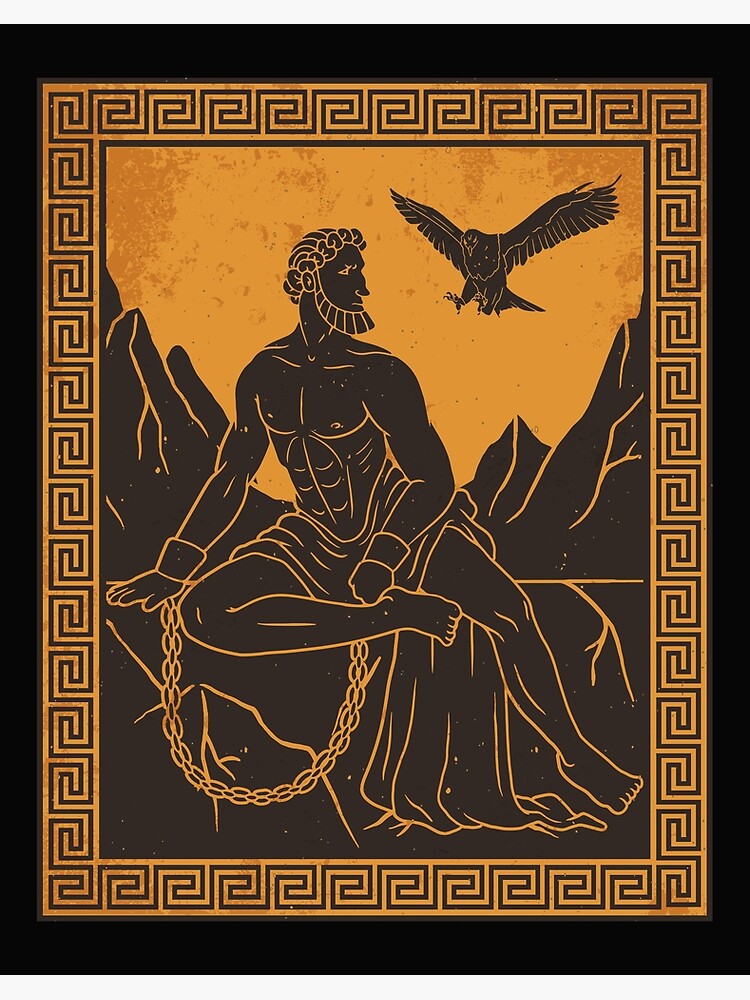
To advance their rhetoric in the 1920s, they referred to the counter-revolution as the many-headed Hydra. They called themselves Promethean heroes bringing enlightenment — science, progress, industry — to the masses, in defiance of “divine” or bourgeois authority.

In monumental Soviet art, giant workers, farmers, and soldiers embodied the Titans, while Tsarism, religion, and Western powers were personified as the “dragon.” Lenin’s Mausoleum, too, drew inspiration from ancient monumental tomb architecture, particularly the Egyptian pyramids.

The examples could go on. Losev was despised mostly for making one point unmistakably clear: ideologies cannot exist without myth. Even when they reject myth and religion as primitive or obsolete, they immediately create new myths to replace them. They ridicule other people’s myths, yet remain blind to the ones they are constructing themselves.

Ideologies need myth as they need air. Their power is drawn from it — and they begin to crumble when their myth grows weak. By the beginning of the 20th century, the Russian Orthodox myth had become very weak. As Nikolai Berdyaev writes in The Truth of Orthodoxy:

“Its external weakness and lack of manifestation, its deficiency of outward activity and realization, have been evident to all.”

The Marxists did not come armed with rational arguments; they came with a well-constructed myth. Arguments do not persuade — myths do.

The utopian myth of “We will build a bright future on this earth” replaced the fading myth of “The Kingdom of God after death.”

If you watch old Soviet films capturing the enthusiasm and fervor of the 1920s, you can still feel the pulse of that mythic energy. Wars are never won with weapons; they are won with myths. The more deeply a nation believes in the truth of its own myth, the more righteous it feels in its mission to prove to others that their myth is false.

Where does the power of myth come from? J.R.R. Tolkien writes:

“We have come from God, and inevitably the myths woven by us, though they contain error, will also reflect a splintered fragment of the true light.”

Marxists’ myths are not all wrong. They contain error, but they also reflect a splintered fragment of the true light. That’s why myths are so appealing! That’s why ideologies need them as air. Every ideology — or rather, idolatry — rests on a half-truth, sometimes even an eighty-percent truth. The danger lies not in falsehood, but in mistaking a fragment for the whole.

The moment we recognize our ideology as myth, we cease to believe in it absolutely. It no longer claims the totality of our lives. We don’t have to reject it, but we must fulfill it — bring it to completion. Every partial narrative must be carried toward wholeness. If we reject one, we will instantly create another. When we renounce one idol, we instinctively bow before its opposite.

Healing doesn’t come through rejection but through transcendence — through seeing the partial in light of the Whole. When we look through our idol — our ideology — we begin to recognize it as a glimpse, a splintered fragment of the true light.

Idols thrive on opposition. They grow stronger when attacked, but they cannot endure being seen through. When we look through them “as through a glass, darkly,” they lose their power and become nothing but good dreams. As C.S. Lewis said in Mere Christianity:

“God sent the human race what I call good dreams: I mean those queer stories scattered all through the heathen religions about a god who dies and comes to life again…”


Check out my 4th book in the Mystical Vision of the Inklings series Fairy Tales for Grown-Ups: Rediscovering Myth and Meaning through Tolkien, Lewis, and Barfield

Invisible Guardians: Who Protected the Borders of the Shire?

Who protected the borders of the Shire? The hobbits were blissfully unaware of who they should thank for the long peace of their land. For many centuries, they lived happily in the Shire, never realizing what terrible creatures roamed just beyond their borders.

Aragorn said:

“Little do they know of our long labour for the safekeeping of their borders, and yet I grudge it not”…”

The Shire’s frontiers were carefully watched by Gandalf and by the Rangers of the North, the remnant of the Dúnedain. They held the darkness at bay, while the hobbits remained completely oblivious to the dangers lurking beyond their green pastures.

One of the most mysterious passages in the Bible—2 Thessalonians 2:7—talks about “the mystery of lawlessness that is already at work, and the one who now holds it back will continue to do so till he is taken out of the way.”

Someone is holding back spiritual darkness this very minute. We don’t know who they are. They are skillful with their spiritual blade, and until they are there, chthonic monsters are kept at bay. We sip our coffee, walk in the park, enjoy the sunset, laugh with friends, watch the news, and think that the fates of the world are decided by the politicians.

They are not. The earth is preserved not by might but by salt. How much salt is needed for the earth not to spoil? Not much. A few grains. Even one blessed man may well be enough. Once, Abraham was bargaining with God about the fate of Sodom. He asked if the city would be spared for the sake of fifty righteous men. God said yes.

Abraham kept bargaining: Forty-five? Forty? Thirty? Twenty? Ten? Each time God said “yes.” Eventually, God sent his angels to rescue the last one—Lot. One grain of salt is enough to keep spiritual darkness at bay. Until that one is taken out of the way, all is well.

When chthonic monsters appear at our borders, it is a sure sign that too few Guardians remain. If the Shire is still lush and green, it must be because of Rangers still standing watch at the edges of the land. Rangers are invisible, unrecognized. When we do see them, we scarcely take notice—they look ragged, forlorn, and forgotten.

And who can tell? Maybe the good earth itself endures only because of one old man hidden away in the heart of New York, Moscow, or Beijing. Such is divine irony (from the Greek eironeía—to “feign ignorance,” or to “play the fool”). We imagine that the peace of the world is preserved in the corridors of power, yet in truth, it may be upheld in a lonely hut somewhere deep in the Siberian taiga.

Chthonic monsters are not afraid of politicians or earthly power. They fear salt and light—those who wield the razor-sharp blade of the Spirit and drive them back by their very presence. Divine irony is inscrutable: it would utterly shatter us if, even for a second, we could glimpse the ones for whose sake the sun still rises over the horizon.

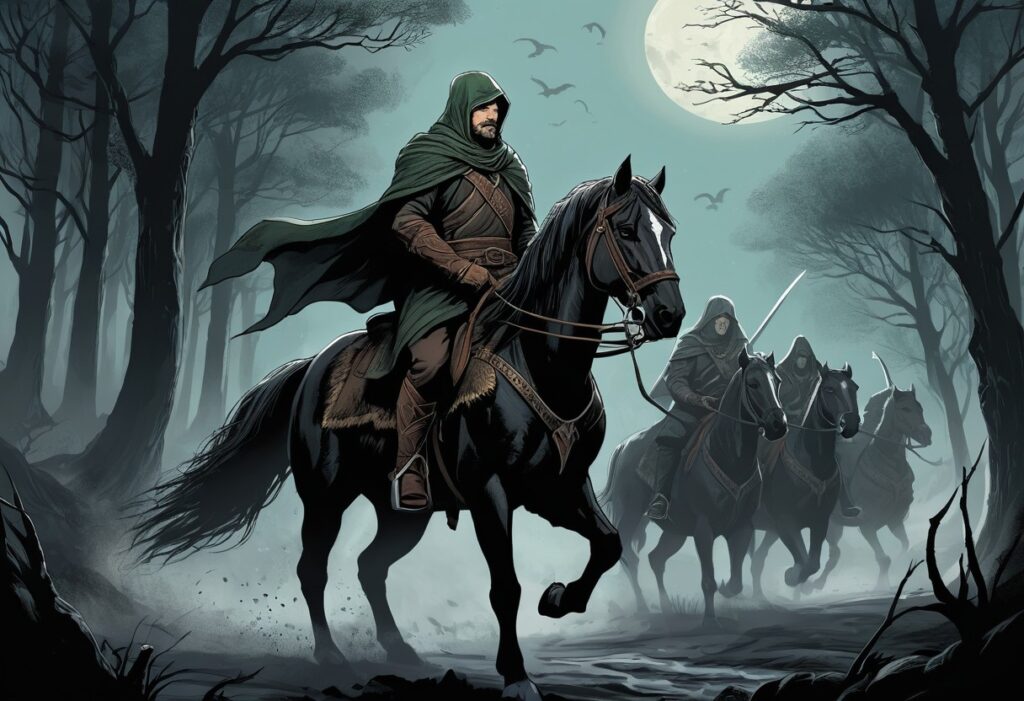
The Rangers of the North walk among us unnoticed—unshaven, weary, cloaked in dust. We, the hobbits of the world, laugh at them or dismiss them, never suspecting that our own laughter still rings because someone, somewhere, wields a power beyond our comprehension.

The true balance of the cosmos is preserved not by kings, but by rejected fools who carry the divine breath in their lungs. Their songs may be too quiet for us to hear, and yet strong enough to hold back chthonic monsters until the first gleam of Dawn.

What Does Saruman of Many Colors Mean?

What does Saruman of many colors mean? Saruman the White was white up to a point. Beyond this point, he only “seemed” white. He said to Gandalf in Orthanc,

“I am Saruman the Wise, Saruman Ring-maker, Saruman of Many Colours!’’

When Gandalf looked, he “saw that his robes, which had seemed white, were not so, but were woven of all colours, and if he moved they shimmered and changed hue so that the eye was bewildered.”

The white that he once was had been broken into many colors. He was now the “rainbow Saruman.” Saruman believed in breaking things to find out what they were. He believed this would give him power. According to Gandalf, he strayed from the path of wisdom,

“And he that breaks a thing to find out what it is has left the path of wisdom.”

When you want to know what something “is,” you can’t break it. You must encounter it as a Whole. Being is holistic. It’s not breakable. It’s not reduceable. A thing that is cannot be less than it is. To know the White one must encounter the White, not break the White into many colors.

For Saruman, the White was only the beginning. He wanted to “use” the White for his purposes. He wasn’t interested in “knowing” the White; he was interested in “using” the White. What you want to know you can’t break. What you want to use you can’t help breaking.

‘‘White!’’ he sneered. ‘‘It serves as a beginning. White cloth may be dyed. The white page can be overwritten; and the white light can be broken.’’

Gandalf wisely retorts,

‘‘In which case it is no longer white.”

A broken white is not white. A whole white is not a thing to be used but a living reality to participate in. Participation is the highest wisdom. Gandalf knew it in his gut. He learned it from Nienna herself, the Queen of Pity when he was her pupil in times immemorial when his name was Olórin. From Nienna, he learned patience and compassion.

He praised Bilbo for showing compassion to Golum — knowing that he had a part to play in the Whole, for better or worse. He trusted that the Hobbits would destroy the One Ring because he had perceived their part in the Great Music. He had learned to be patient and wait for the Whole to unfold. That’s why he became Gandalf the White — or Saruman as he should have been.

Later, Tolkien would write in his Mythopoeia,

Man, Sub-creator, the refracted light
through whom is splintered from a single White
to many hues, and endlessly combined
in living shapes that move from mind to mind.

The White can either be broken or refracted. When broken and used, it ceases to be white. When refracted to be encountered, it remains the Living White — and creates a symphony of colors. When we encounter the Living White, it passes through us and gets refracted to many hues without being diminished.

Everyone who participates in the Living White shines with refracted light. They become sub-creators, each refracting the White in his or her own way.

Melkor’s Lies: How to Remove the Fear of Death

Image Courtesy

How to remove the fear of death? Speaking of the beginning of days, The Silmarillion says that Ilúvatar gave Men “strange gifts.” First, he set eternity in their hearts so they would always desire to go beyond the visible world:

“But to the Atani I will give a new gift.’ Therefore he willed that the hearts of Men should seek beyond the world and should find no rest therein; but they should have a virtue to shape their life, amid the powers and chances of the world, beyond the Music of the Ainur, which is as fate to all things else.” The Silmarillion

Second, he gave them a gift of finiteness.

“Death is their fate, the gift of Ilúvatar, which as Time wears even the Powers shall envy.”

But what is there to envy? Why would even the Valar envy Men? It turns out that in the beginning, Men didn’t fear death. Fear of death was instilled into their hearts by Melkor who deceived them by saying that it was Iluvatar’s punishment rather than a gift.

“But Melkor has cast his shadow upon it, and confounded it with darkness, and brought forth evil out of good, and fear out of hope.”

Melkor’s shadow had a name; its name was Ungoliant—a monstrous spider born out of his envy. She was neither an Ainur nor Maiar. Most likely, she was Melkor’s Shadow-Self, his own insatiable darkness, which he feared. It was Ungoliant who first spun a spiritual darkness called Unlight, for it was made in mockery of light.

“The Light failed; but the Darkness that followed was more than loss of light. In that hour was made a Darkness that seemed not lack but a thing with being of its own: for it was indeed made by malice out of Light.”

The darkness that existed before was not a spiritual darkness—it was merely an absence of light. That first darkness was part of a good creation. When the Elves awakened at the Bay of Cuiviénen, they beheld the stars of Varda in the night sky for a long age. There was nothing scary about it. Light and darkness were but paints in the hand of Iluvatar.

Ungoliant infused the first darkness with malice, filling it with “nets of strangling doom.” She cast Melkor’s shadow on it. Darkness became a source of existential fear. Later, Melkor cast his shadow upon the gift of Iluvatar—Man’s mortality. He deceived Men into believing that death was not a gift but a doom, and they started craving immortality. Eventually, they decided to seize it by force, which led to the fall of Numenor.

Melkor impressed upon the hearts of Men that death was a punishment—a severing from Iluvatar. Distorted by Morgoth’s lies, death became a mockery of God’s gift—Men’s ability to leave the Circles of the World and be renewed. While the Elves were bound to the fate of the world, growing weary of its unending cycles, Men were granted the grace to depart and be renewed.

In the beginning, there was no more fear in dying than in falling asleep. Men knew they would get up “in the morning” refreshed. They simply let go of their consciousness and slept, until newness, freshness, rest, restoration, and hope overtook them.

Curiously, most people who have had a near-death experience report that after their return, they no longer fear death. A friend of a friend—who died of a brain tumor, saw heaven, and returned after being miraculously healed—says she doesn’t fear dying anymore. She says, there is no death. You don’t even lose consciousness.

“What struck you the most in Heaven?” asked the person who interviewed her. She answered, “That God is a Sound—an ineffable and irresistible Sound that you hear everywhere: in all things, in others, and in yourself.”

What is True Art? Tolkien and Heidegger on Art vs. Machine

What is true art? Speaking of “The Machine” in On Fairy-Stories, Tolkien contrasts it with organic, sub-creative work of a true artist or storyteller.

By the [Machine] I intend all use of external plans or devices (apparatus) instead of development of the inherent inner powers or talents—or even the use of these talents with the corrupted motive of dominating: bulldozing the real world, or coercing other wills.

So, what is the Machine? It’s anything external I use to force my will upon the world. According to Tolkien, the Machine differs from Art (sub-creation) in that it arises from a desire to amplify self-will rather than from an attunement to the Music of Ilúvatar.

All true Art, which is the province of the Elves, proceeds from one’s inner alignment with the Great Music. The Elves first hear the Music and then express it through their Art. Their purpose is to attune to the Thought of Ilúvatar in all things and to pour this harmony into the world. In contrast, the purpose of the Machine-creator is to attune to self-will and devise ways to impose it upon the outer world.

Art is prayer springing from: “Thy will be done”the Machine is anti-prayer springing from: “My will be done.” Art is internal; the Machine is external. In The Lord of the Rings, Tolkien insists that evil cannot be defeated by wielding the Power of the Ring.

You can make the Ring into an allegory of our own time, if you like: an allegory of the inevitable fate that waits for all attempts to defeat evil power by powerLetter 96 to Christopher

When we use external means to defeat external means we amplify the external means. The Machine perpetuates the Machine. Power cannot defeat power. Paradise cannot be achieved through external means. Only the renunciation of power can overcome power. Art is the ultimate renunciation of external power and amplification of the internal power—the intrinsic power of Being.

That’s why the Art of the Elves is not technology. It may look like technology—Elvish ropes, robes, fials, boats, lembas bread, blades, ploughs, bows, harps, bowls, etc.—its purpose is not domination but the manifestation of the Great Music in the world. All Art taps into spiritual power and brings it into the physical realm, which is the ultimate triumph over evil.

The “products” of Art reveal the Music. That’s why the Elvish rope burns Gollum’s neck—he can’t bear the “sound” of the Great Music. That’s why all Elvish things ward off evil, not through external force but by the light they emanate. The “power” of Sting lies not in its external properties but in how much Divine light it carries.

Elvish tools—chisels, harps, hammers, bowls—are not technology in the conventional sense of the word but an organic part of the creative process. Elvish boats are carved with Elvish knives, each infused with a prayer to Elbereth. Elvish tools are not “external means” to bend reality to the Elvish will; they are an outer expression of their inner attunement to the Higher Will. So, what is true art?

As Heidegger says in his essay The Question Concerning Technology, modern technology is not just an instrument — it’s a way of revealing (aletheia). It reveals how we view the world. It is a Gestell (enframing) — a rigid framework that configures our vision, causing us to see everything as a resource. Its purpose is to order and command nature, not to listen to its Song.

Modern technology doesn’t hear any Song, and it teaches us not to hear it either. It limits our perception of reality, reducing everything—including humans—to mere means to an end. After renouncing the nature of modern technology as a Gestell, Heidegger concludes,

Because the essence of technology is nothing technological, essential reflection upon technology and decisive confrontation with it must happen in a realm that is, on the one hand, akin to the essence of technology and, on the other, fundamentally different from it. Such a realm is art.

Does Magic Exist in Middle-Earth?

Does magic exist in Middle-Earth? After the Company had received miraculous gifts from the Elves of Lothlórien — lembas bread, ropes made of hithlain, superlight boats, and “magic” cloaks — Pippin asked:

‘Are these magic cloaks?’ asked Pippin, looking at them with wonder.

‘I do not know what you mean by that,’ answered the leader of the Elves. ‘They are fair garments, and the web is good, for it was made in this land. They are Elvish robes certainly, if that is what you mean. Leaf and branch, water and stone: they have the hue and beauty of all these things under the twilight of Lorien that we love; for we put the thought of all that we love into all that we make.’

Whatever Elves make looks like technology but feels like music. They make in the law in which they were made. They infuse all they make with Music of Iluvatar whence they came. They hearken unto the Music and capture it in whatever their hands touch. All they create is prayer — attuning to the celestial Music and letting it flow into the world.

Music doesn’t manipulate. Beauty never coerces; it invites. Take it or leave it. It’s not going to force you. The Machine, on the other hand, does force. It is not made from a desire to capture the Music. It is made from a desire to dominate. The Machine is the opposite of prayer. Prayer is about: “Thy will be done”; technology is about: “My will be done.”

The heart of the Machine is bulldozing reality to fit my will. The heart of prayer is tuning in to the invisible Law behind all things and reflecting it in whatever you do. That’s why the art of the Elves is not technology even though it looks like technology. Their creations are spun from prayer — their attunement to the Great Music.

When you pray, you create art. When you seek to bend reality to your desires, you build the Machine. When you pray, you don’t think about your desires — your only desire is to become small and be caught by the mighty Flow of Beauty. When you wish to dominate, all you think about is how to force the world to fulfill your desires.

The fundamental difference between art and technology lies in the will. It’s either: “Thy will be done” or: “My will be done.” As Martin Buber pointed out, God is either Thou or “it.” When God is Thou, he invites you into a personal relationship with him — to join the Great Dance. When God is “it,” no relationship is possible. The only way to relate to “it” is through domination.

When we don’t see the Divine behind visible phenomena, we seek to dominate the phenomena. They become mere instruments to fulfill my wishes. If I see the world as “it,” not Thou, I create the Machine. If I see God as Thou, not it, I see his Presence behind all phenomena and create Art.

Art may look very similar to technology, but it feels like Music. Art is humble; its desire is to become small so the Music can be big. That’s why all the Elvish gifts had such incredible power. They were infused with the power of the Music of creation captured through prayer and contemplation.

“Spirit is not in the I, but between the I and the Thou.” – Martin Buber

What is Donegality in C.S. Lewis and J.R.R. Tolkien?

Image Courtesy

What is donegality? Leonardo da Vinci’s Vitruvian Man represents the “perfect man,” based on the ancient knowledge of ratios and proportions in human anatomy. Leonardo, often called a Renaissance man, depicted something very different from the medieval understanding of man.

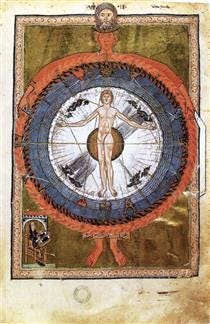
His Vitruvian Man is autonomous. There’s nothing around him. He is in the center. In the visions of Hildegard of Bingen, born in 1098, a man is also depicted in the center, except that the space/cosmos he is in is surrounded by the figure of God. The man is literally inside the womb of God.

In the medieval understanding, the man is in the center, and yet he is not. He exists in God’s embrace. The space/womb he is in is part of a Universal Body that has a head, face, hands, legs, and feet. The medieval man was not autonomous. He was loved. Embraced by the personal cosmos.

He lived, breathed, and moved inside the Divine womb. When the baby is inside the womb, they can’t see the mother, but they can divine her motherly presence in all things. She is hidden behind the walls of the world, and yet she is present in everything. The baby literally eats her body and lives off of her — her body is his whole world. The mother is hidden and yet revealed from the inside out.

C.S. Lewis once visited County Donegal in Ireland and was struck by the specific feel of the local landscape. He coined the term “donegality” to describe the unique atmosphere or mood that gives a particular setting or narrative its distinctive character. Donegality is a unique feel of something.

The Chronicles of Narnia is intentionally suffused with a certain donegality so we can recognize the Mother. All its symbolism — the talking animals, mythological landscapes, magical transformation — the whole atmosphere creates an irresistible sense of wonder and and an invitation to ask the main question: “Who?” Who is behind it?

To be born means to go out of the womb and see the mother face to face. But while we are in the womb, we live in her donegality. We see her dimly, as if through the looking-glass. We swim in the cosmos of her Divine Body, eating and drinking her self-revelations.

In J.R.R. Tolkien’s worlds, this “donegality” is even more pronounced because Iluvatar, the Divine Source, is mentioned only in the beginning of The Silmarillion. In the rest of the legendarium, he is not mentioned but implied. He is the force behind all forces. An attentive reader divines his Presence in all the peripeteia of the plot. Tolkien plunges us into the donegality of the Music of Iluvatar.

Both Lewis and Tolkien represented a deeply medieval understanding of man. The man is only himself when he is embraced by the cosmos of Divine love. The Divine love puts him in the center and nourishes him until he is ready to see her face to face. When in the womb, he sees her only in dreams, visions, symbols, metaphors, and parables. She is revealed from the inside out.

St. Gregory Palamas (1296–1359), a Byzantine monk and theologian, taught that even though God is unknowable in his essence, he is revealed in his energies. While in the womb, we cannot see God face to face, but we can know him partially through his energies. God manifests himself through his donegality, the unique atmosphere of the world.

That’s why Jesus said, “He who has ears, let him hear.” Hear what? The heartbeat of the mother, the warmth of her womb, the nourishment of her Body. When we feel embraced, we become ourselves. Divine donegality gives us the energy to be who we are.

Why Did Tolkien Like Trees?

Why did Tolkien like trees? Trees are fascinating — they grow upward and downward simultaneously. Their root system, if the soil is deep enough, resembles the way the branches grow.

The tree stretches itself both up and down at the same time. The more grounded it is, the more it stretches its hands to the Sun. The more it stretches its hands to the Sun, the more grounded it is.

The symbolism of the tree is vast and manifold. Ultimately, the tree is an image of who we are. We have two legs to stand firmly on the ground and two hands to reach to the Sun. J.R.R. Tolkien, a great lover of trees, captured this symbolism in Galadriel’s strange gift to Sam — a seed of the mallorn-tree.

Sam was the gardener. He was “down to earth.” A perfect helper for Frodo, he could always return him to sanity. Hobbits represent rootedness. They lived in the roots of the trees where they dug their smials. After living in the roots for centuries, they became rooted in the soil. They were, so to say, the roots of the world.

And yet, Sam yearned to see the Elves. He was rooted and grounded and yet, his hands spread out to the Sun. The more you are rooted, the more you grow. He was down to earth, and yet his soul longed for the lofty beauty of the Elves. The Elves of Lothlórien lived in the trees. That’s where they built their houses with flets. They lived among the branches and the leaves. They were in touch with the beauty of heaven.

Galadriel knew that Shire would soon be uprooted, so she gave Sam the undying symbol of new hope. The mallorn tree was a symbol of both rootedness and loftiness. In it, the hobbits met with the Elves. Sam and his descendants would live in the roots, but they would always look up at the tree top waving in the wind and think of the beauty of Lothlórien.

Galadriel gave Sam the gift of himself. He was the mallorn-tree. Rooted in the soil, he yearned for the skies.

“He [Sam] took the seed in his hand, and looked at it with wonder. ‘This is a gift from the Lady Galadriel,’ he said. ‘A piece of the tree of Lothlórien, a piece of the Elves, and of her grace. A thing that might grow into a living memory of a land that was once so beautiful. I will plant it in the Party Field where the old tree stood.’”

We are all trees. We have a dual nature. We are from the earth, and we are from heaven. We are hobbits and Elves at the same time. We live on the Vine that grows up to the sky. We are its branches. Our roots go down into the earth, and our hands reach up to the Sun. No wonder on many medieval frescoes, Christ was depicted as a Vine with disciples sitting on its branches. We are the Tree as we participate in the great Vine, which is the Tree of Life.

Check out my book on Amazon!