What is Donegality in C.S. Lewis and J.R.R. Tolkien?

Image Courtesy

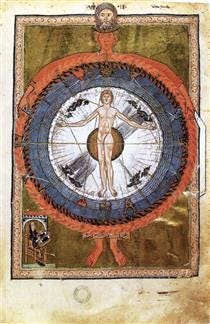
What is donegality? Leonardo da Vinci’s Vitruvian Man represents the “perfect man,” based on the ancient knowledge of ratios and proportions in human anatomy. Leonardo, often called a Renaissance man, depicted something very different from the medieval understanding of man.

His Vitruvian Man is autonomous. There’s nothing around him. He is in the center. In the visions of Hildegard of Bingen, born in 1098, a man is also depicted in the center, except that the space/cosmos he is in is surrounded by the figure of God. The man is literally inside the womb of God.

In the medieval understanding, the man is in the center, and yet he is not. He exists in God’s embrace. The space/womb he is in is part of a Universal Body that has a head, face, hands, legs, and feet. The medieval man was not autonomous. He was loved. Embraced by the personal cosmos.

He lived, breathed, and moved inside the Divine womb. When the baby is inside the womb, they can’t see the mother, but they can divine her motherly presence in all things. She is hidden behind the walls of the world, and yet she is present in everything. The baby literally eats her body and lives off of her — her body is his whole world. The mother is hidden and yet revealed from the inside out.

C.S. Lewis once visited County Donegal in Ireland and was struck by the specific feel of the local landscape. He coined the term “donegality” to describe the unique atmosphere or mood that gives a particular setting or narrative its distinctive character. Donegality is a unique feel of something.

The Chronicles of Narnia is intentionally suffused with a certain donegality so we can recognize the Mother. All its symbolism — the talking animals, mythological landscapes, magical transformation — the whole atmosphere creates an irresistible sense of wonder and and an invitation to ask the main question: “Who?” Who is behind it?

To be born means to go out of the womb and see the mother face to face. But while we are in the womb, we live in her donegality. We see her dimly, as if through the looking-glass. We swim in the cosmos of her Divine Body, eating and drinking her self-revelations.

In J.R.R. Tolkien’s worlds, this “donegality” is even more pronounced because Iluvatar, the Divine Source, is mentioned only in the beginning of The Silmarillion. In the rest of the legendarium, he is not mentioned but implied. He is the force behind all forces. An attentive reader divines his Presence in all the peripeteia of the plot. Tolkien plunges us into the donegality of the Music of Iluvatar.

Both Lewis and Tolkien represented a deeply medieval understanding of man. The man is only himself when he is embraced by the cosmos of Divine love. The Divine love puts him in the center and nourishes him until he is ready to see her face to face. When in the womb, he sees her only in dreams, visions, symbols, metaphors, and parables. She is revealed from the inside out.

St. Gregory Palamas (1296–1359), a Byzantine monk and theologian, taught that even though God is unknowable in his essence, he is revealed in his energies. While in the womb, we cannot see God face to face, but we can know him partially through his energies. God manifests himself through his donegality, the unique atmosphere of the world.

That’s why Jesus said, “He who has ears, let him hear.” Hear what? The heartbeat of the mother, the warmth of her womb, the nourishment of her Body. When we feel embraced, we become ourselves. Divine donegality gives us the energy to be who we are.

Why Did Tolkien Like Trees?

Why did Tolkien like trees? Trees are fascinating — they grow upward and downward simultaneously. Their root system, if the soil is deep enough, resembles the way the branches grow.

The tree stretches itself both up and down at the same time. The more grounded it is, the more it stretches its hands to the Sun. The more it stretches its hands to the Sun, the more grounded it is.

The symbolism of the tree is vast and manifold. Ultimately, the tree is an image of who we are. We have two legs to stand firmly on the ground and two hands to reach to the Sun. J.R.R. Tolkien, a great lover of trees, captured this symbolism in Galadriel’s strange gift to Sam — a seed of the mallorn-tree.

Sam was the gardener. He was “down to earth.” A perfect helper for Frodo, he could always return him to sanity. Hobbits represent rootedness. They lived in the roots of the trees where they dug their smials. After living in the roots for centuries, they became rooted in the soil. They were, so to say, the roots of the world.

And yet, Sam yearned to see the Elves. He was rooted and grounded and yet, his hands spread out to the Sun. The more you are rooted, the more you grow. He was down to earth, and yet his soul longed for the lofty beauty of the Elves. The Elves of Lothlórien lived in the trees. That’s where they built their houses with flets. They lived among the branches and the leaves. They were in touch with the beauty of heaven.

Galadriel knew that Shire would soon be uprooted, so she gave Sam the undying symbol of new hope. The mallorn tree was a symbol of both rootedness and loftiness. In it, the hobbits met with the Elves. Sam and his descendants would live in the roots, but they would always look up at the tree top waving in the wind and think of the beauty of Lothlórien.

Galadriel gave Sam the gift of himself. He was the mallorn-tree. Rooted in the soil, he yearned for the skies.

“He [Sam] took the seed in his hand, and looked at it with wonder. ‘This is a gift from the Lady Galadriel,’ he said. ‘A piece of the tree of Lothlórien, a piece of the Elves, and of her grace. A thing that might grow into a living memory of a land that was once so beautiful. I will plant it in the Party Field where the old tree stood.’”

We are all trees. We have a dual nature. We are from the earth, and we are from heaven. We are hobbits and Elves at the same time. We live on the Vine that grows up to the sky. We are its branches. Our roots go down into the earth, and our hands reach up to the Sun. No wonder on many medieval frescoes, Christ was depicted as a Vine with disciples sitting on its branches. We are the Tree as we participate in the great Vine, which is the Tree of Life.

Check out my book on Amazon!

Is Winnie-the-Pooh Wise?

Is Winnie-the-Pooh wise? The two most sane characters in literature, Tom Bombadil and Winnie-the-Pooh, are poets.

“The poet only asks to get his head into the heavens. It is the logician who seeks to get the heavens into his head. And it is his head that splits.” G.K. Chesterton

They are poets to such a degree that they speak in rhyme about everything. They see poetry in everything. Sanity is all about seeing the world as a multi-layered nesting doll for you to open up and explore.

“Imagination does not breed insanity. Exactly what does breed insanity is reason. Poets do not go mad; but chess-players do.” G.K. Chesterton

Poets don’t go mad. They don’t rely on their reason. They don’t try to get the heavens into their heads. They already have the heavens in their heads — that’s what poetry is. The presence of heaven informs their minds, which is the very definition of sanity.

Tom Bombadil is J.R.R. Tolkien’s absolute metaphor for pure poesis — the Divine making. The world was created through poesis — speaking Divine words: “Let there be light. And it was light.” This is poetry at its pinnacle.

Tom Bombadil, who calls himself “the Elder,” was the first one to see the first dust of the universe. He is the pure poesis, the speaking of the world into being. The world is still held together by poetry.

“He [The Son of God] holds everything together with his powerful word.” Hebrews 1:3

Tom Bombadil is unaffected by the One Ring. He is immune to insanity. He is like the awakened Neo in The Matrix who is able to see the code behind the world. The code is poetry. He sees it and speaks it — 24/7. He knows that the world is spun from words. He doesn’t look for words; words look for him.

Winnie-the-Pooh’s head is also in that word-heaven. He famously said,

“Poetry and Hums aren’t things which you get, they’re things which get you. And all you can do is go where they can find you.”

Winnie-the-Pooh is another paragon of sanity. His every sentence is just as silly and whimsical as Tom Bombadil’s and yet they reveal incredible profundity of perception.

“People say nothing is impossible, but I do nothing every day.”

Behind his hilarious puns hides a world of meaning. Obviously, nothing is not nothing, it is everything. It is something full of potentiality. It’s the womb of the world. That’s what poets do 24/7 — birth the world into being through speaking. Speaking out of nothing. That’s how God created the world.

Winnie-the-Pooh took words out of Heidegger’s mouth (or the other way around), who said that “nothing” is inextricably connected to being.

His “Das Nichts nichtet” means “The nothing nothings” — nothing is not merely the absence of something but an active force. A poet does nothing every day — because he does everything. Winnie-the-Pooh’s nothing is everything, just like Tom Bombadils silly songs are nothing, and yet they order the Old Forest.

Old Man Willow obeys Tom’s silly song because Tom is Master. He is Master because he knows how the universe is ordered and run. It is ordered and run through words. He goes around his realm, he picks flowers for Goldberry, he talks to the trees — he does “nothing.” Every day. He is too connected to being to waste his time on trifles.

Sanity is art. Sanity isn’t the thing you get; it’s the thing that gets you when you leave the trifles of the world and do the only productive thing in the world — the nothing of Tom Bombadil and Winnie-the-Pooh.

Check out my 3rd book in the Mystical Vision of the Inklings series Daily Spiritual Readings from Literature Classics.

What Was Wrong with Lord Denethor?

Image Courtesy

What was wrong with Lord Denethor? Denethor, the Stewart of Gondor, was sure he knew the future. He had one of those ancient seeing stones, Palantír. He looked into it regularly and was convinced that the battle against evil was lost. He saw too much to doubt it.

“Why do the fools fly? Better to die sooner than late, for die we must.”

When Gandalf told him to fight Mordor, he got enraged,

“Do you think the eyes of the White Tower are blind? I have seen more than you know.”

He thought he knew beyond a shadow of a doubt what the future held. This “knowledge” drove him insane. The illusion of absolute knowledge is the best recipe for insanity. As Chesterton puts it, the mind of an insane person always “moves in a perfect but narrow circle.” The function of the Palantír was to draw the person into that narrow circle and lock him in it.

“If you or I were dealing with a mind that was growing morbid, we should be chiefly concerned not so much to give it arguments as to give it air, to convince it that there was something cleaner and cooler outside the suffocation of a single argument.” G.K. Chesterton, Orthodoxy

Denethor believed that Palantir was broadening his horizons but in reality, it was narrowing his field of vision. It showed only the things that aligned with the will of the one who ruled over the seeing stones. Slowly, Denethor’s “small circle of thought” became so small that he started suffocating in it.

Gandalf came to Gondor as a gust of fresh air and said, “Fight.” You don’t know the future beyond a shadow of a doubt. No one does.

“Despair is only for those who see the end beyond all doubt. We do not.”

Who knows what the next day will bring? You never know what forces are at work in this particular circumstance of your life. All you need to do is to recognize the necessity and take the next step.

“There are other forces at work in this world, Frodo, besides that of evil.”

What do we know about the future? Nothing. To recognize it is wisdom. This realization helped Chuck, Tom Hanks’s hero in Cast Away, to remain sane on his uninhabited island for four years. After being rescued, he told his friend what helped him to go on day after day without any hope of getting out of this prison. He said,

“I just continued living, breathing, until one day, everything changed. The tide gave me a chance… So I know what I will do now. I will continue to live because tomorrow will be a new day, and who knows what it will bring?”

Day after day, he continued living not knowing… until one day, the tide brought him a piece of plastic that he turned into a sail. Now he could get over the huge surf waves.

That’s exactly what Gandalf said to Aragorn, Gimly, and Legolas when they met him in the woods after his unexpected resurrection,

“I come back to you now at the turn of the tide.”

We never know what the tide will bring today. That’s why we continue living and breathing. It is not folly, as Denethor thought. It is wisdom. We don’t see the end. That’s why we are waiting for the turn of the tide.