Why Wasn’t the Ponte Vecchio Bombed During World War II?

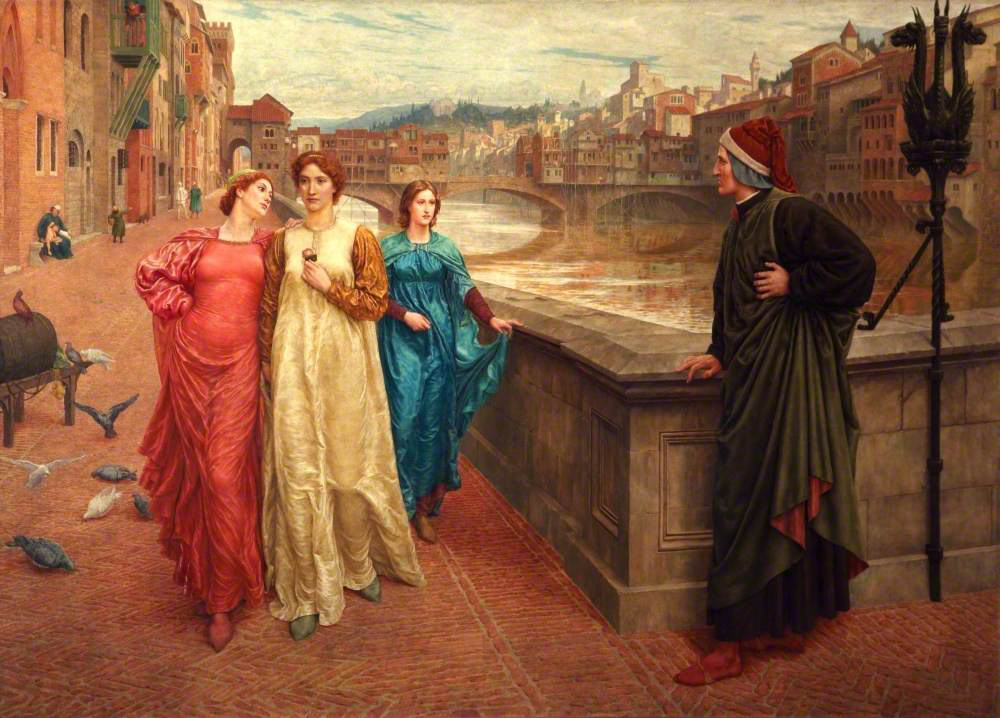
Holiday, Henry; Dante and Beatrice; Walker Art Gallery; http://www.artuk.org/artworks/dante-and-beatrice-97987

Why wasn’t the Ponte Vecchio bombed during World War II? World War II is full of its legends. In the summer of 1944, as Allied forces closed in on Florence, retreating German troops were ordered to destroy every bridge over the Arno to slow their advance.

Every bridge was blown up — except the Ponte Vecchio. The German officer assigned to demolish it refused. “This is the bridge where Dante met Beatrice,” he said. “I cannot possibly destroy it.”

He then radioed the Allies and informed them that the bridge would remain intact — on one condition: they must promise not to use it. The agreement was honored, the Ponte Vecchio was spared, but the officer himself was executed for disobedience.

What compelled this man to sacrifice his life for a bridge? The bridge must have spoken to him about something worth more than life itself — the beauty of the Divine hidden behind ordinary things. Dante’s love for Beatrice was unique in that he never separated his love for an earthly woman from his love for God.

In fact, loving Beatrice was not a distraction from God but the very path to God. For Petrarch — and many other poets — their earthly love was a distraction from God. Petrarch’s inner struggle was precisely that Laura competed with God for his heart.

He loved her intensely, but he also felt guilty that this human passion distracted him from pursuing God. Not so with Dante. He said of Beatrice:

O lady, you who strengthen my hope
and who, for my salvation,
have suffered to leave your footprints even in Hell…

For him, to see Beatrice was to see God. Beatrice became an icon of the Divine — a revelation of God within the physical realm. Dante’s revolutionary thought was precisely this — that whatever you love on earth can lead you to God if you see it as an icon.

If you don’t see it as an icon, it becomes an idol and competes with the Divine in your heart. It’s all in the eye of the beholder.

“The eye is the lamp of the body.” — Jesus

Icon and idol are often the same thing — the difference lies in how we look. If we look at a thing, it becomes an idol. If we look through it, it becomes an icon. Dante looked through Beatrice and communed with Divine Light.

Perhaps that is what the German officer saw on the Ponte Vecchio that day. Perhaps he caught a glimpse of that light through the bridge and realized that it was worth more than life itself.
What Happens When Cupid Hits You With an Arrow?

What happens when Cupid hits you with an arrow? Cupid, the Roman god of love, is often depicted with a bow and arrows. He represents something undeniable in human experience: when we fall in love, we feel pierced — wounded, smitten, and yet strangely alive. Beauty never misses the mark — it strikes us awake.

When we are struck by beauty, it wounds us in the heart. When Cupid shoots, it’s never hit-or-miss. We may lead a loveless life for years on end until, out of the blue, something catches us completely off guard. We stand in awe and suddenly realize there’s no going back.

The mythic intuition behind Cupid’s bow and arrows is this: all of life is archery. We aim at happiness in everything we do—and we often miss. The Greeks named this failure ἁμαρτία (hamartía), from the verb ἁμαρτάνω (hamartánō)—“to miss the mark.” In later Jewish-Christian Greek, hamartía becomes the standard word for “sin.”

When we hear the word “sin,” we hear all sorts of moral connotations. Not so in classical Greek. In Greek, anyone who missed the mark had “sinned.” Sin is what humans do: we hit and miss. We shoot — and miss the mark. We shoot at happiness but don’t get it. That is sin.

The Russian word погрешность (“margin of error”) still shares the root грех (“sin”). Погрешность simply means a limit of error. And yet, paradoxically, there is no limit to human error — unless we open ourselves to being wounded. Beauty never misses the mark; its mark is our hearts.

We shoot for happiness but miss it; it cannot be achieved that way. Happiness dwells at the point of Cupid’s arrow when it comes swooshing out of the blue. To be happy, we must open our hearts to divine arrows.

The only way to protect ourselves from the fiery darts of the Evil One is to make ourselves completely open to the arrows of God. The only way to “sin less” (as in: miss the goal of happiness less) is to allow yourself to be smitten by the One who doesn’t miss.

“Sinning less” is not a matter of effort — our own shooting — but of letting go of all shooting and allowing yourself to be pierced. The fiery darts of the Evil One make us close our hearts. When we are wounded by the poisoned darts of the Evil One, we shut down and stop feeling.

Refusing to feel is the ultimate sin (missing the mark), because by “not feeling” we take our last, desperate shot at some form of “happiness.” Paradoxically, the only true antidote to the poison of satanic darts is Divine love — Cupid’s arrows. When enough Divine arrows pierce our hearts, the poison in satanic darts is neutralized.

One of Estonia’s national parks is divided into several sections — each dedicated to a particular kind of silence. The idea behind the park is that people need to hear the many voices of silence. Each voice opens the heart to be wounded by Divine love.

Cupid doesn’t waste his arrows — he doesn’t shoot at a closed heart. He waits until we have taken all our shots at happiness and become desperate and brokenhearted. A broken heart is much closer to healing than a closed one.

A broken heart can feel. It is vulnerable enough to receive Cupid’s healing arrows. When we are vulnerable and open, we do not miss the mark. We wait in silence for the swoosh of God’s healing arrows to smite us and bring us back from the dead.