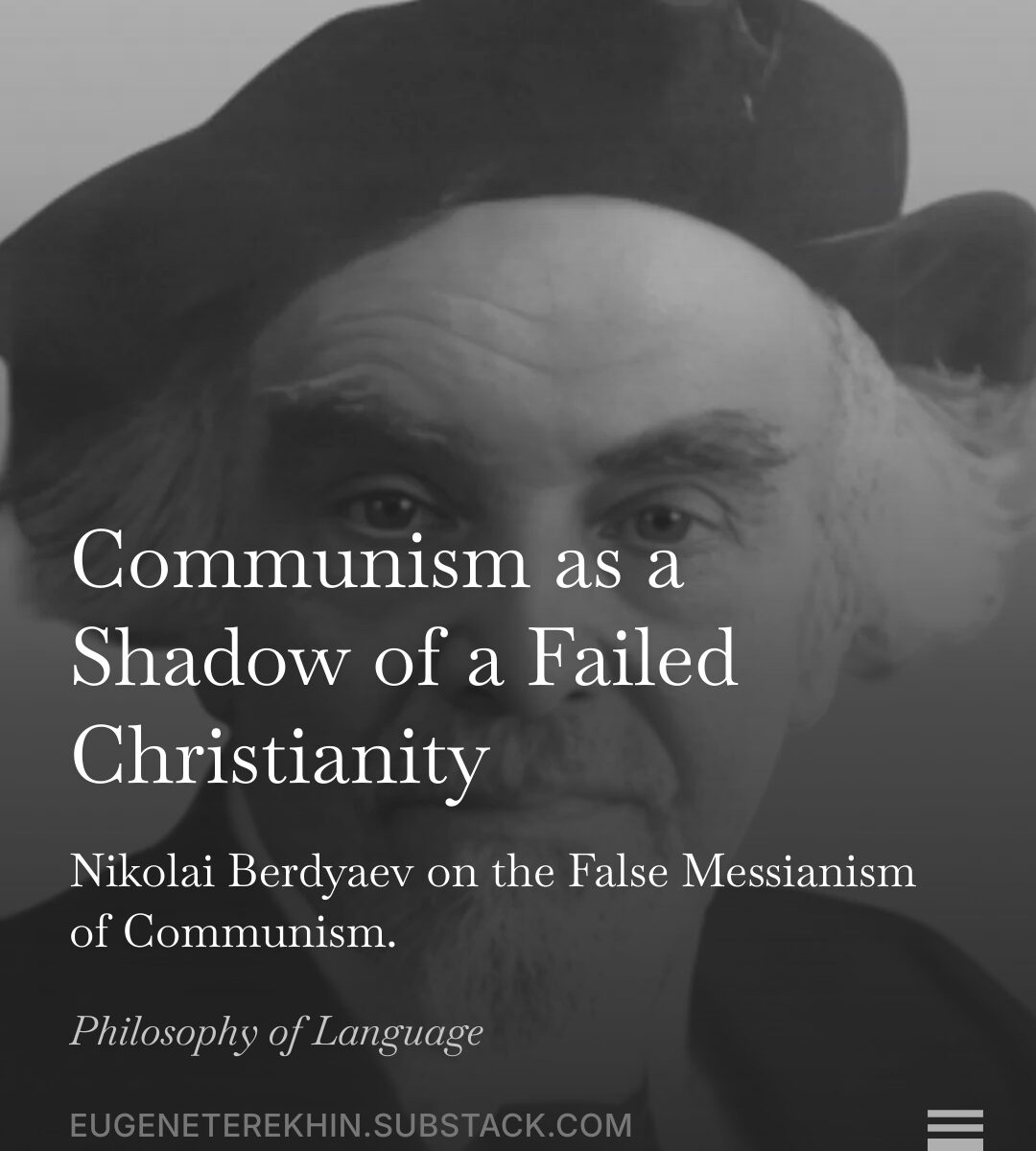
What are the origins of Communism? According to the Russian philosopher Nikolai Berdyaev, Communism cannot be destroyed. It can only be transcended — in the Spirit.
Communism is a shadow, and a shadow cannot be eliminated as long as something is casting it. As Carl Jung poignantly noted,
“Mere suppression of the shadow is as little of a remedy as beheading would be for headache.” — C. Jung, Psychology and Religion
What is Communism a shadow of? Berdyaev writes that Communism is a distortion of the Messianic idea. Sergei Bulgakov called Communism “a form of secular Chiliasm” — a belief in the Golden Age on earth (man-made Heaven).
Communism is a dark side of the belief in Chiliasm — the Kingdom of Heaven on earth. Berdyaev explains that Communism as ideology was born in Europe not because people were fed up with the excesses of Capitalism but because Christianity had failed to transcend both.
He writes,
“The false religion of Communism is a substitute for Christianity.” — The Russian Idea
More precisely, it is a substitute for Christianity’s failure to transcend its own shadow. In Berdyaev’s view, Communism is the shadow of a failed Christianity. Communism makes promises strikingly similar to those of Christianity — social justice, equality, brotherhood, and so on — but claims that these ideals can be imposed by force.
The falsehood of Communism is in the claim that the Kingdom of Heaven can be forced from the outside. It’s not something that freely arises in the heart of a human being moved by God. It is something that can be achieved by introducing an external system.
In the Kingdom of God, people treat one another with brotherly love, justice, compassion, and care freely, moved by Divine love. Under Communism, Divine love —the only true source of real motivation — is replaced by externally imposed morality.
That is why Berdyaev emphasizes that Communism cannot be destroyed; it can only be transcended when Christianity finally confronts its own shadow. Christianity must recognize that unless it reveals how love springs freely from the heart in response to divine beauty, it will inevitably give rise to a cult.
Love for others is good and divine, but it cannot be forced. Either it arises naturally when we are touched and moved by the Spirit, or it degenerates into an externally imposed duty and becomes a road to Hell.
In the Kingdom of Heaven, there is no need for Communism. Brotherly love arises spontaneously as a response to divine love — the Love that moves the sun and the other stars.
As the Apostle Paul wrote, “For Christ’s love compels us.” Communism imposes the Second Commandment while ignoring the First. In effect, it says: “Love your neighbor as yourself” because you must, not because God’s love stirs you freely from within.
Communism inevitably emerges as a reaction to the excesses of Capitalism. When people worship capital rather than God, the oppressed become angry and seek to establish social justice by force. They are motivated by anger, not moved by love. And whatever is driven by anger leads to Hell.
Love does not impose change from the outside; it fosters it from within. The true Kingdom is within us. The abuses of capital cannot be countered by abusing the Second Commandment. Without the First Commandment, both love of neighbor and the pursuit of capital will degenerate into inhumanity.
When the First Commandment remains first, both love for neighbor and the use of capital become natural — prompted by love. We love our neighbor not because we are forced, but because we feel loved, and this love compels us from within.
We use capital not because we want more, but because we enjoy multiplying our talents and blessing others.
Berdyaev writes that a human being can become truly human only by rising above their own humanity. We must transcend our human dimension to become truly human. When we focus too much on being humane, we become inhumane. When we embrace our divinity, we become truly human.
Interested in the spiritual connection between the inner and outer? Leaf through my book