

Is God Defined in the Bible?

Is God defined in the Bible? As Sergei Averintsev, a Russian literary scholar, once wrote, in all of Scripture, there’s only one clear instance where Aristotelian logic “A=B” is used.

Hebrews 11:1:

Now faith is confidence in what we hope for and assurance about what we do not see.

Faith equals confidence.

All the other instances of “this is that” are metaphors or similis: “This is like that.”

When Jesus says “I am the door,” He doesn’t mean “I equal the door.” He means “I am like the door.” The door is a metaphor of Jesus, not definition.

What is the difference between a metaphor an definition? Definitions seek to explain. Metaphors reveal what is hidden.

When we want to make something clear, we usually say: “Define this…” We rarely say: “What is it like?” Yet Scripture consistently favors metaphor over definition. Why?

Because definitions often miss the nature of reality. Reality is a sign. It points beyond itself.

Every door points to Christ. Every breath of wind points to the Spirit. Every human being is an icon of God.

Definitions try to make things clear, yet miss the point. The point is not what Kingdom of God is; the point is what it is like.

Only when we know what it is like, do we know what it is. The river rustling beneath my feet in Estes Park this morning is a mysterious sign. It is like something else.

What?

I must look for a metaphor, not a definition.

Today the river rustles with newness. Ever flowing, never stopping, always washing, always refreshing, never the same — it is the River of Life.

The river is the metaphor for life. Not simply as a flow of time, but as a never-ending flow of newness. You can never step into the same river twice. It’s always new.

In the same way, I have never seen this day before. I have never seen this sun, this mountain, this aspen. They are brought before my eyes by the River flowing from an invisible Source.

I have never before been baptized — immersed — into the River of Today. I have not yet been washed anew by this flow of invisible newness. But it’s coming. I must have eyes to see and ears to hear. The river of life is bubbling beneath my feet.

Every coming moment is pregnant with rebirth. Every moment rustles with metaphors and similies. The only way to know is to be reminded of likeness. The moment we know what something is like we know what it is.

The moment we define a thing, we reduce it to less than it is. The moment we are struck by a metaphor, reality opens itself to us.

When God says, I AM WHAT I AM, it’s not a definition, even though it looks like A=B.

“I AM WHAT I AM” is not a definition but a refusal to be defined.

That God is Being cannot be explained — it must be caught. Like a fish in the river of time. Like a trembling leaf on an aspen. Like the sleepy face of a child.
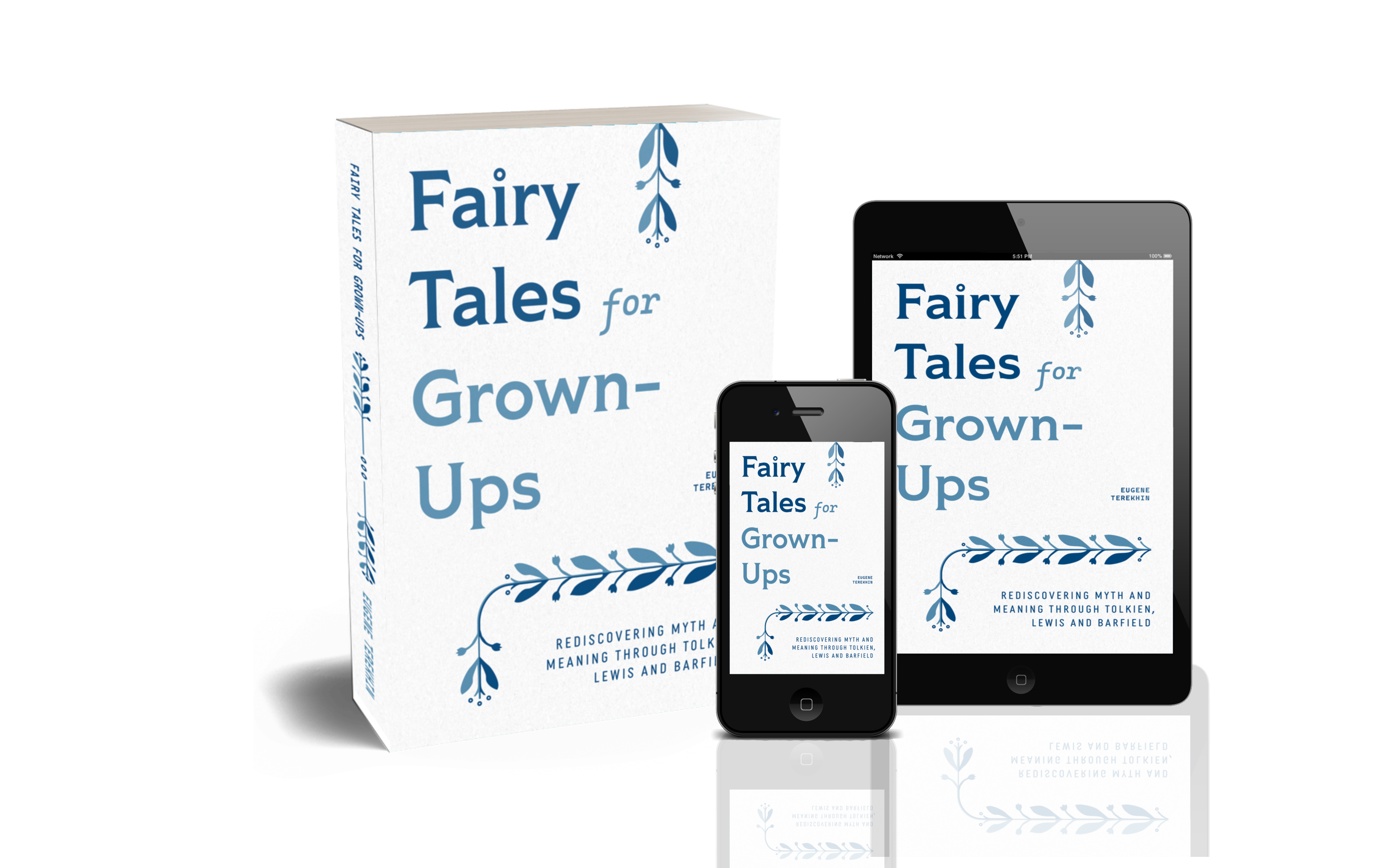


Read more in my book:

How Can We Truly Know Anything?

How can we truly know anything? In Poetic Diction, Owen Barfield argues that meaning is not static. When a logician attempts to fix the meaning of a term, it is inevitably reduced.

Try to define the word “home,” and you are left with something that is no longer much of a home. Try to define your spouse, and before long, you no longer have a spouse.

The meaning of “home” is revealed only to the one who dwells in it poetically. The meaning of “spouse” is revealed only to the one who dwells with them poetically.

According to Barfield, meaning emerges when the poet — maker in Greek — through inspiration, stumbles upon a fresh metaphor that stirs and shifts human consciousness.

“The poet’s relation to terms is that of a maker.” — Poetic Diction

In other words, unless I look at my spouse and allow a fresh metaphor to strike me unexpectedly, I reduce her to less than she is. But if I find the metaphor — or rather, if the metaphor finds me — the meaning will be revealed as a felt change of consciousness.

Modern consciousness recognizes only static meaning because it is bound to a particular lens — the lens of non-participation. That is why the modern world has so little meaning: such a view is inherently reductive.

It assumes that meaning can be grasped by definition, captured within an affixed description, as though it existed independently of the one who perceives it.

But there is no such thing as fixed, static meaning. The Logos of a thing is revealed only in between — in the living relation between myself and the thing. Meaning arises as I participate in it — through inspired metaphor.

The word “meaning” itself has a curious etymology. It comes from the Old English mǣnan, which means “to intend” or “to signify.” Surprisingly, the noun mean (as in Golden Mean) comes from a related Old English term “gemǣne.” Both mǣnan and gemǣne trace back to one common Proto-Indo-European root: mei- / moi-, which means to bind, unite, exchange, have in common.

In other words, meaning arises within a certain means — within a medium, in the shared space, in-between. Signification is revealed only through participation.

Barfield quotes Aristotle:

“The making of metaphors is by far the most important; since this alone does not involve borrowing from somebody else and is [therefore] a mark of genius; for to make a good metaphor is to contemplate likeness.” — Poetic Diction

A good metaphor is inspiration itself — it comes directly from the Spirit revealing the Logos. True metaphor doesn’t borrow anything from anyone; through imagination it ascends directly to God and is granted the gift of Mercurial speech.

Then, it strikes us with a magical wand of sound and shifts our consciousness to contemplate True Likeness. At that point, we no longer need definitions — we know.

What Does “Swallow” Mean in Greek Mythology?

What does “swallow” mean in Greek mythology? In Ancient Greece, swallows were a symbol of the soul and were closely associated with the goddess Aphrodite, the goddess of love and beauty. Experts in the Greek lore say that if you look for an explanation of this metaphor in ancient Greek literature, you won’t find much. It’s just there. Without any explanations.

However, if we look at the swallow closely, we might deduce the answer. Swallows are the fastest birds in the world, flying at record speeds of up to 45 miles per hour. But what’s even more intriguing is that they are mostly aerial birds — that is, they spend most of their time in the air.

Landing is dangerous and landing on the ground is deadly. If a swallow lands on the ground it can’t take off. It is doomed. It must start its flight by falling from a high place. That’s why swallows build their homes in riverbanks so they can take off immediately after falling out of the nest.

In other words, a swallow can only fly if there’s a possibility of falling. If it’s impossible to fall, it is doomed. It must be at some elevation always, and this place should be high enough to make the fall possible.

The human soul is like a swallow. When it stops flying, it dies. It lives in the air. Its wings must be spread most of the time. For the soul to fly, there must be a possibility of a fall. However, the soul cannot land in a low place. Low places are dangerous and fatal unless the soul is lifted by an outside force.

It is dangerous for the soul to be in a place where no flight is possible. The soul lives in the air. When it knows that no flight is possible, it dies. The “low place” is when the soul realizes that it will never fly again. The soul must avoid low places for a good reason — that’s how it’s made.

The soul is made to fly. When it knows it can’t take off, it’s too depressing to continue living. What makes the soul fly is love and beauty. The soul must be in the presence of Aphrodite most of the time. Love and beauty elevate the soul. When it doesn’t see love and beauty, it risks landing in a low place.

The soul needs love and beauty like air. That’s how it’s made. When it doesn’t see Aphrodite, it shrivels up. It can’t fly.

We must build our nests in a high place. There must be some possibility of a fall there, otherwise there’s no possibility of a flight. But we must always have love and beauty before our eyes to remain in the air. We must never land. The soul can only rest on an elevation. When the soul is low, it’s restless.

Restlessness is a sign that the soul is low. It’s a sign that it needs to be elevated by love and beauty. Love and beauty lift it up and give it enough space to fall and soar. That’s when the soul is at its fastest. When the soul is full of love and beauty, it moves at record speeds. It becomes alive.

The soul’s restlessness is a sign of too much hate and ugliness. Hate and ugliness kill the soul. They bring it too low. The soul is not made to live in hate and ugliness. It instinctively looks for a riverbank where it can nest and rest. It wants to see the river, the sky, the clouds, the trees, the flowers. These things inspire it to fly.

It falls out of the nest and is carried by the wind across the vast expanse just like the newborn Aphrodite was carried by Zephyrus to the shores of Cyprus.

Check out my new book Daily Spiritual Readings from Literature Classics