
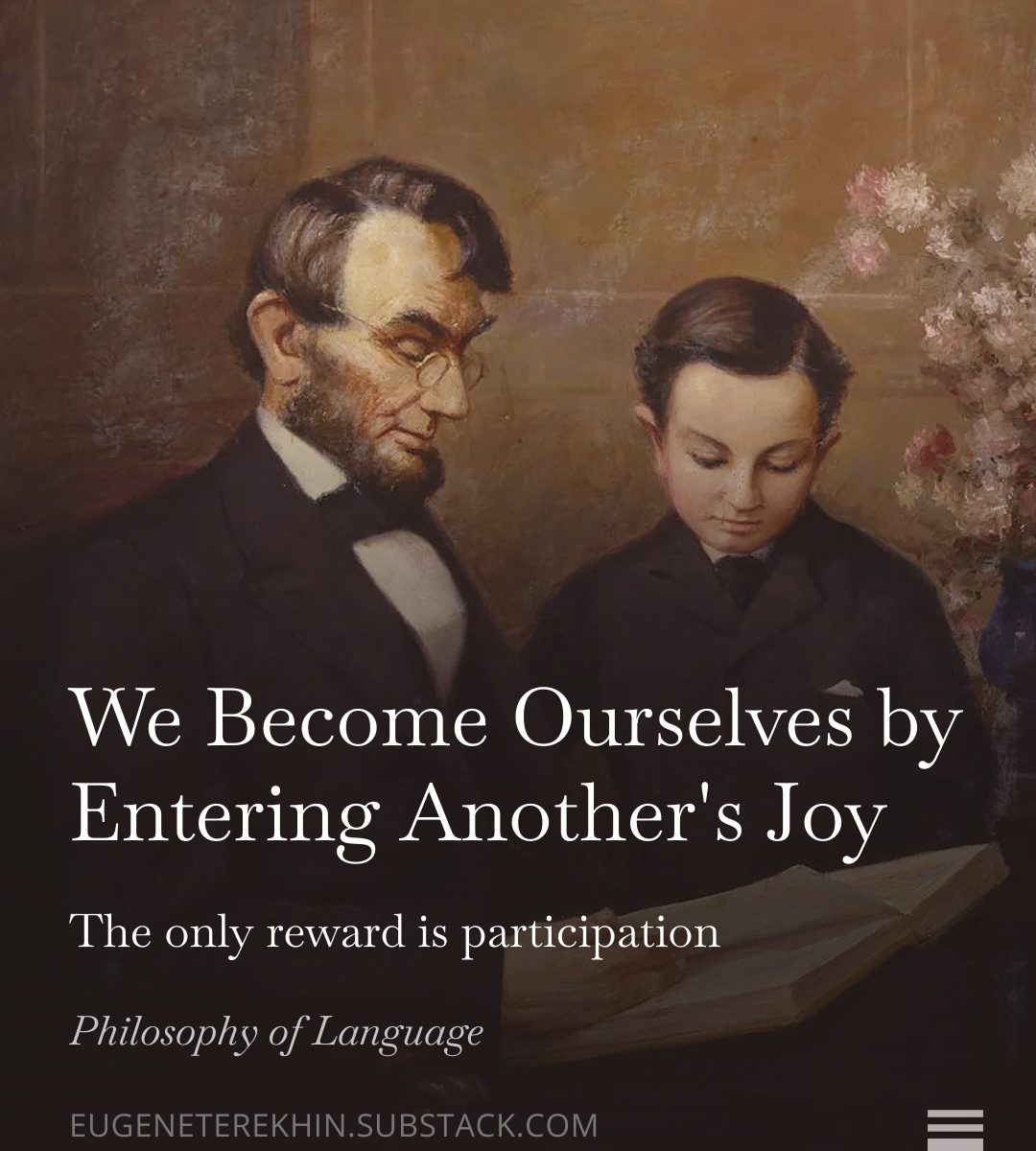
What does it mean to enter into the joy of your master? When I first read the Parable of the Talents in Matthew 25, it sounded somewhat transactional:
“Well done, good and faithful servant… Enter into the joy of your master.”
It sounded as though the master were saying, “Good job. You have done what you were told — here is your reward. You may go home now.”
Yet the phrase “enter into the joy of your master” did not sound like a reward in the usual sense of the word. It sounded more like an invitation to remain — not to receive a reward and go.
Entering someone’s joy is not a payment in the proper sense of the word. I cannot ask my children to do the dishes or mow the lawn and promise my joy in return. This action, in and of itself, cannot bring them into my joy. Entering someone’s joy is not a transaction.
I grew up with an absent father who did not have much joy. I sensed it deeply. There was nowhere for me to enter. There was nothing in his way of life so appealing that I wanted to share in it.
In the parable, however, the master clearly has joy, and this is obvious to the servant; otherwise, the invitation to enter it would make no sense.
The servant obviously wants the joy, not the payment. He senses that joy from afar. And he realizes that the only way to enter the joy is to use his talents.
The joy comes over him the more he exercises those talents — or, to use Aristotle’s phrase, the more he “performs activities inherent in his being” (Eudemian Ethics). Aristotle understood happiness as the overflow of inner harmony: a person flourishes when he acts in accordance with who he is.
When we do what we were made to do, we enter the Maker’s joy.
Does the Maker have joy?
We know the answer only by getting in touch with our inmost self and “performing the activities inherent in our being.” The Maker’s joy is revealed and confirmed in us only when we do what we were made to do.
We know the Maker’s joy because it is already present in what we do. It motivates us not because of some external reward awaiting us in the future but because of what we are experiencing now.
That is what children secretly long for when they look at their parents. Their silent question is: “Is there a joy that I can enter?”
They watch and wait. If they see our joy, they long to participate in it — by becoming more of themselves. When a child catches a glimpse of the father’s joy, they can’t help but want it. They begin to instinctively search within themselves something that taps into that joy.
The vision of the father’s joy draws out the best in them. The more they become who they are, the more they enter into their father’s joy. The father’s joy is our primary reality in which we become ourselves.
Perhaps that is why the ancients called the brightest star in the sky Jupiter — literally, the Bright Father. They understood that without contemplating the father’s joy, we cannot be ourselves. They portrayed Jupiter as a ruddy-faced, joy-beaming merry fellow.
As Franco Nembrini, an Italian pedagogue says, the secret of raising children lies in not being preoccupied with raising children. It lies in pursuing your own joy and inviting them to share in it. When we are focused on the children, they sense our misplaced focus and go somewhere else.
We are all searching for the Bright Father—and the Bright Mother. The pursuit of joy is not optional; it is essential. Genuine joy is contagious. When we encounter it in someone, we suddenly realize that we want to stop pretending and become ourselves.
For we can enter that joy only by tapping into our own being and acting from that invisible source.
Plunge into two months of spiritual reflections.
