
What is the best definition of reading? About a year ago, my wife and I looked at the quiz questions our son had received at school about Ray Bradbury’s Fahrenheit 451. We were shocked. The questions focused on almost everything except what Ray Bradbury’s book was actually about.
“What type of drug did the Mechanical Hound inject into Montag’s leg?” “How did Montag reach the ‘book people’ — by train, bus, or on foot?”
What does it matter?
I started looking for questions about the meaning of the novel, but I found none. They all focused on technical details that had little or nothing to do with the text’s deeper significance.
I am sure the school’s goal was simple — to test the students’ “knowledge” of the book. But such a test also reveals something about the way the modern mind understands “reading.”
Based on what the school was testing, reading is seen as gathering and retaining “data points.” But is this reading?
As I thought about it, I looked for the origin of the verb “to read.” It comes from the Old English verb rǣdan, which meant “to counsel, advise, or interpret the signs.”
For some reason, I thought of a passage from Matthew 16:1-4, where Jesus rebukes the Pharisees for asking Him to show them a sign from heaven:
“You know how to read the appearance of the sky, but you can’t read the signs of the times.” — (CSB)
Here, to read clearly means “to interpret the signs.” Many English translations use the word “discern” or “interpret” here. Ironically, the pharisees were asking Jesus for a sign from heaven when the sign from heaven was standing in front of them!
They could “read” the face of the sky — they could gather data points — but they could not read the signs.
This seems to be the disease of our time as well: we see signs everywhere, but we are unable — or unwilling — to see beyond the external sign to what is being signified. We take those signs for the ultimate reality as if gathering information about a book were the same as reading the book.
What does reading mean? It means rǣdan — interpret the signs. The point of Fahrenheit 451 is not in How did Montag reach the ‘book people’ — by train, bus, or on foot? but that they were “book people.” The point of the story is the encounter with books incarnated in people.
You can ask ChatGPT to gather all the data about the book and analyze it, but it is not the same as being suddenly struck by what lies beyond those “signs.” To read means to be struck by the meaning that comes from beyond what’s written. The meaning of the book is not in what is written but in what the written signs point to.
Any book is an invitation to go beyond the book. If I focus exclusively on gathering data points and convince myself that I am “reading,” I may miss the sign from heaven standing right before my eyes.
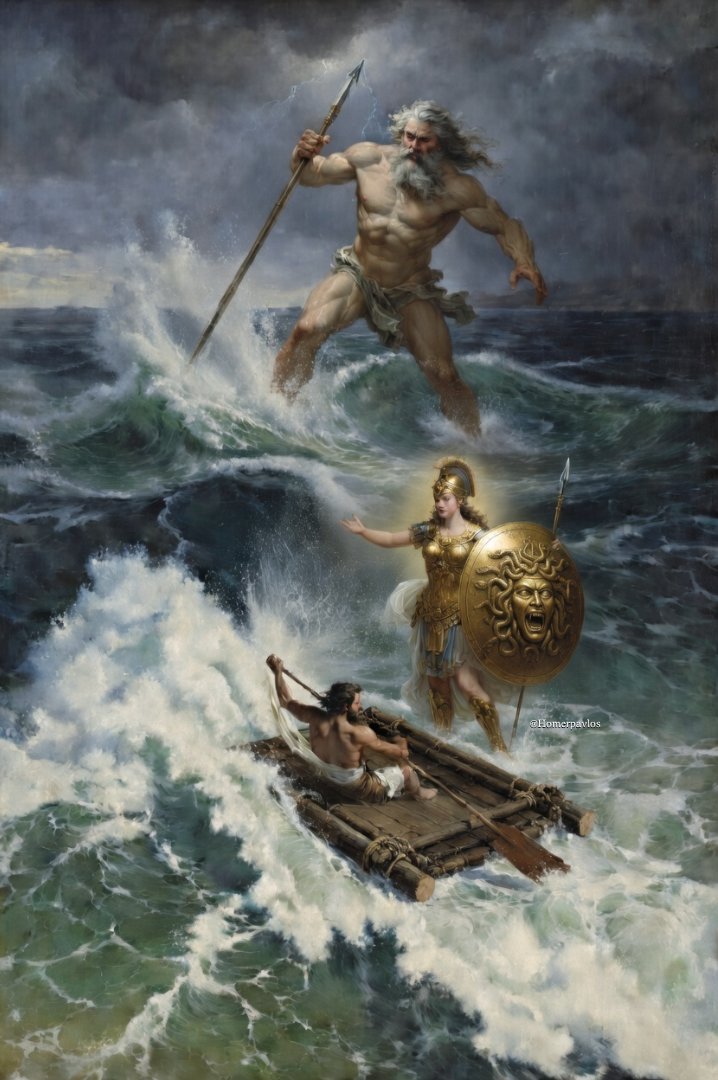
In Book 5 of the Odyssey, Poseidon’s storm destroys Odysseus’ raft. Odysseus struggles to make it to the land, but he is about to be hurled against the rocks. Suddenly, Homer says that Athena puts a thought into his mind: he should swim along the coast until he finds the mouth of a river, where he can safely enter the land.
As I listened to this episode in the audiobook yesterday, I thought: “Why would Homer say that Athena put this thought into his mind? Why not simply say, “Odysseus thought…”?
The answer came as if from the depths of the Mediterranean sea: “When you are drowning, you become highly sensitive to the voices of the gods. You are too poor in spirit to believe you can save yourself.”
This is not written in the Odyssey. It comes from beyond the text. It is something the Spirit impresses upon you. True reading is recognizing the writings of the Spirit upon your own heart.
What if reading means seeing what isn’t written?