
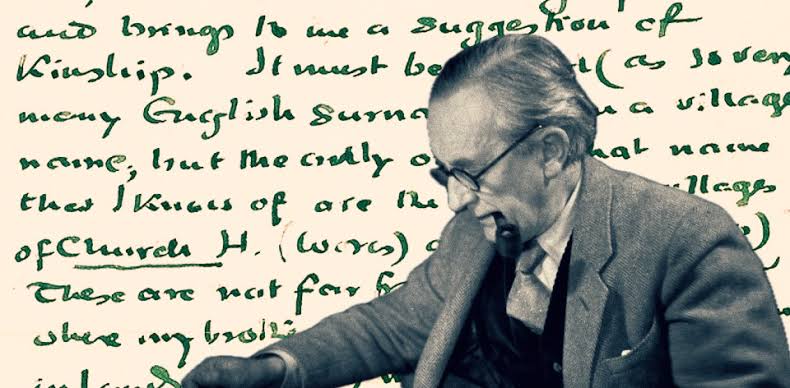
What is the Void in Tolkien’s The Silmarillion? In The Silmarillion creation myth, Tolkien speaks of the Void, which he later calls Kúma.
Kúma is a Quenya term for the Void, which means the Night without form or time in which the world was set.
The Void is the Outer Darkness, a region devoid of the Flame Imperishable. But it is not a physical space. It is an existential reality symbolizing the absence of the Secret Fire that makes all things alive.
Yet, Melkor — the Satan of Tolkien’s world — goes often into the Void to seek the Flame Imperishable. Why? Because he craves to “bring into Being things of his own,” which would be separate from the Music of Ilúvatar. But he cannot find the Flame, because it is with Ilúvatar.
What happens in the soul when it cuts itself off from the Great Music? It plunges into the Void. Feeling its own consuming emptiness, it seeks to create something separate, something outside itself that might fill it from without — but it cannot.
The Void symbolizes the existential reality where the empty soul goes to to fill its own emptiness. But it cannot. All attempts to fill the inner void from within the Void are doomed. No void can be filled from within the Void.
We all seem to know that.
Tolkien conceived The Silmarillion in 1917, while on sick leave during the First World War. Christopher Tolkien recalled that his father began The Silmarillion “in army huts, crowded, filled with the noise of gramophones.”
In hindsight, Tolkien realized that the war had pushed him to imagine a world of beauty and wonder beyond the Void into which humanity was plunging. Yet, the Void doesn’t equal evil. It is the Absence of the Flame Imperishable — the Outer Darkness.
Amid the outer darkness of the trenches of World War I, Tolkien sensed most acutely that there was only one power capable of filling the Void: the Music of the Ainur.
“…and the music and the echo of the music went out into the Void, and it was not void.” — The Silmarillion
The inner void cannot be filled from within the Void. It is only filled from beyond itself — by “the music and the echo of the music.”
And then, lo and behold, what was empty is suddenly filled to overflowing. The Void itself is not void. If our inner void is filled but a little, it is no longer void. Something has entered it. An echo of some unnamable Beauty, which is also a call.
To Melkor, the Void became his doom. In the end, he was cast into the Outer Darkness — the endless roaming, forever seeking what he cannot find. For Tolkien, however, the Void became a mighty amplifier of the “echo of the Music.”
No problem — whether existential, political, or relational — can be solved from within the Void. When we feel empty, we begin roaming the Void, seeking relief, but we cannot find it there. It is not there. It is in the Great Music.
We must catch and amplify its echoes in any way we can. These faint echoes are strong enough to enter the Void, and then it is no longer void. The Walls of the Night have been pushed back.
In the trenches of World War I, while Tolkien was immersing himself in the Kalevala, he was catching the faintest echoes of the Music. And he caught them. The Kalevala fed his imagination. He caught the reverberating echoes of Heaven amid the hell of human making.
Later he confirmed that the stories
“arose in my mind as ‘given’ things… I had the sense of recording what was already ‘there’, somewhere: not of ‘inventing’.” — The Letters of J.R.R. Tolkien
Interested in exploring how the inner void can only be filled by the Music of Ilúvatar?
I am developing this theme in-depth in my book: